
Part 2 opens at home, almost a month after the return. Sensible conversation on some subjects has not necessarily changed Don Quixote's commitment to knight-errantry.
On this page
Characters and setting
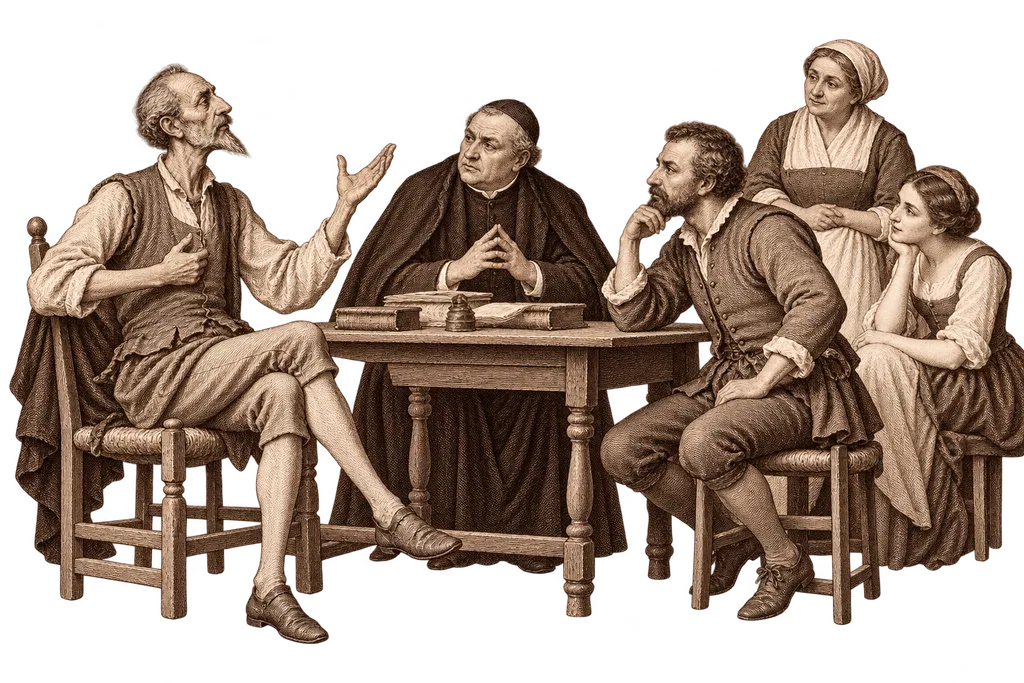
Characters: Don Quixote, the priest, the barber, the housekeeper and the niece. Setting: Don Quixote’s house, almost a month after his return.
Summary
The priest and barber visit Don Quixote, whose housekeeper and niece believe he has improved. They discuss government, and he sounds judicious. When the priest mentions the Turkish threat, the knight proposes assembling knights-errant capable of defeating its armies. The barber tells of a man confined in Seville who seems sane until declaring himself Neptune. Don Quixote recognizes the insinuation and defends his calling. The conversation continues with descriptions of literary knights whom he treats as real people.
What to notice
The Seville story mirrors the visit: Coherent discussion ends in a claim that undermines apparent recovery. Don Quixote understands and rejects the comparison.
Analysis
Eloquence and fantasy continue to coexist. The visitors seek a test but also provoke and enjoy the replies, which complicates their claim to impartial judgment. The barber's story makes an indirect argument. Recognizing its insulting implication displays a competence that does not necessarily involve revising the belief under attack.
A reflection for today
Someone can argue skillfully while retaining a conviction that is hard to substantiate. The exchange encourages evaluating a claim's grounds without treating verbal fluency as sufficient proof. This interpretation neither establishes a contemporary diagnosis nor turns the barber's tale into a medical procedure.
Sources and edition
This guide uses Cervantes’s text in Francisco Rodríguez Marín’s La Lectura edition (1911–1913), volume 5, II.1. Verifiable locator: Identifier donquijotedelama05cerv, scan images 27–52 (zero-based digital index). The heading and selected passages were visually checked; the complete notes were not collated. Analysis and present-day reflection are this guide’s commentary.

