A quiet meeting contrasts Don Diego's domestic life with knight-errantry. Conversation moves from the disguised strangers to a son's wish to write poetry.
On this page
Characters and setting
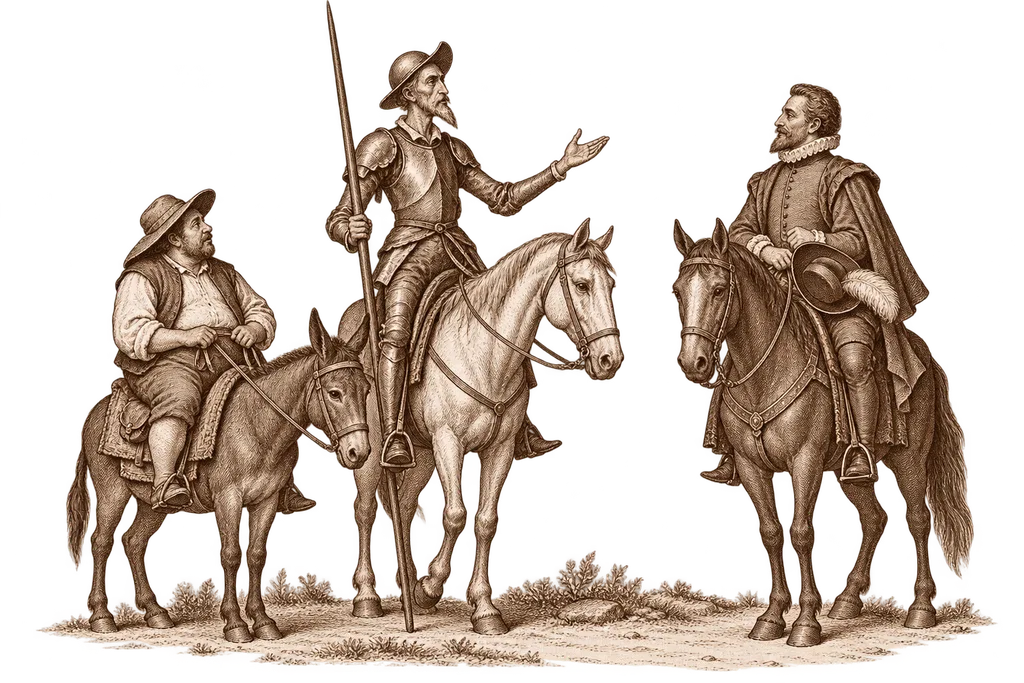
Characters: Don Quixote, Sancho and Don Diego de Miranda, the Gentleman in Green. Setting: The road where the travelers meet Don Diego.
Summary
Sancho still believes the other squire really was Tomé Cecial. Don Quixote replies with his theory of enchanters. They meet Don Diego de Miranda, a gentleman dressed in green who describes his family, reading and orderly way of life. He explains that his son prefers poetry to the careers he had hoped for. Don Quixote advises respecting that inclination. He discusses poetry in different languages, the relation between natural talent and practice, and restraint in satire. An approaching cart interrupts their meeting.
What to notice
Don Diego does not introduce himself as an adventure's hero. His account of everyday life offers a different measure of conduct and reading.
Analysis
Don Quixote can speak attentively about a family difficulty while retaining a fantastic explanation of recent events. That alternation prevents every statement from being judged through a single label. His defense of the son's vocation also raises a conflict between parental expectations and personal inclination.
A reflection for today
Supporting a vocation involves more than praising its prestige or dismissing it as impractical. The conversation encourages listening to the person who must pursue it and considering the work it requires, rather than treating parental wishes as the only measure.
Sources and edition
This guide uses Cervantes’s text in Francisco Rodríguez Marín’s La Lectura edition (1911–1913), volume 5, II.16. Verifiable locator: Identifier donquijotedelama05cerv, scan images 279–299 (zero-based digital index). The heading and selected passages were visually checked; the complete notes were not collated. Analysis and present-day reflection are this guide’s commentary.

