A cart is carrying two lions to the royal court. Don Quixote turns their journey into a test of courage that also endangers everyone nearby.
On this page
Characters and setting
Characters: Don Quixote, Sancho, Don Diego de Miranda, the lion keeper and the carter. Setting: The road beside the cart transporting the lions.
Summary
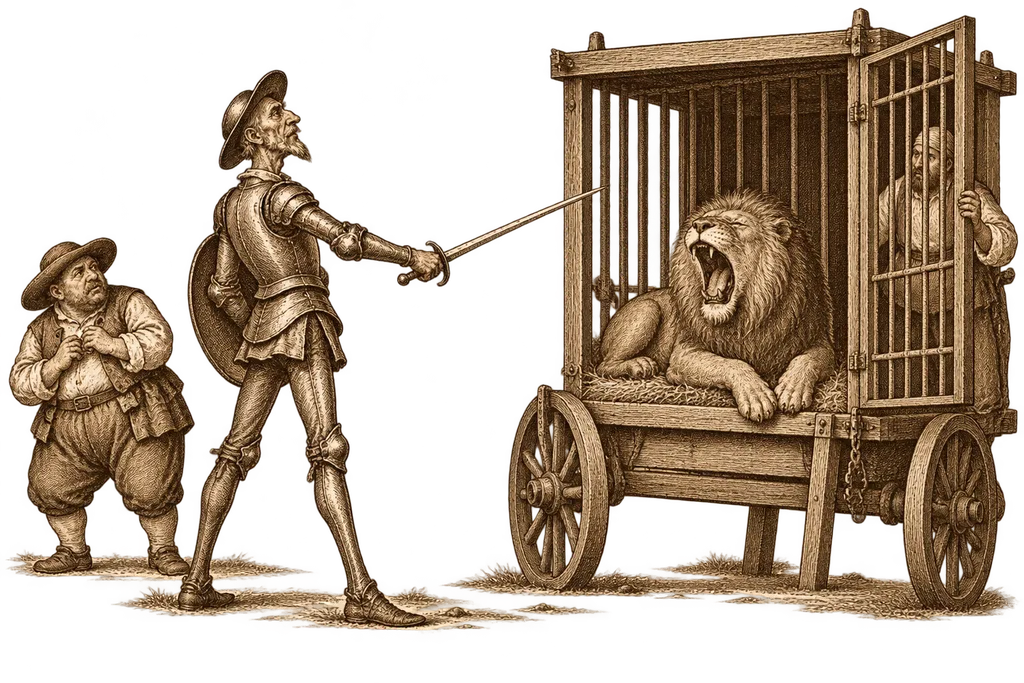
Sancho stores curds in his master's helmet. When Don Quixote puts it on, whey runs down his face. After that incident, the knight demands that a lion's cage be opened. Don Diego and Sancho try to dissuade him; the others retreat, and the carter protects his mules. The keeper opens the cage. The lion stretches, yawns, looks out and lies down again without attacking. The keeper refuses to provoke it and persuades Don Quixote that his courage is already established. The knight asks for testimony and adopts the name Knight of the Lions.
What to notice
Don Quixote does not physically defeat the animal in combat. His declared victory depends on the lion's refusal to emerge and the keeper's subsequent account.
Analysis
Don Quixote understands the distinction between courage and recklessness but prefers excess to the appearance of cowardice. The carter offers another perspective: His animals are his livelihood. One man's search for fame creates possible costs for people who did not choose it.
A reflection for today
A public display of daring can spread risk among people who will not share its reward. Before celebrating the gesture, the scene encourages us to ask who makes the decision and who would bear the consequences of failure.
Sources and edition
This guide uses Cervantes’s text in Francisco Rodríguez Marín’s La Lectura edition (1911–1913), volume 5, II.17. Verifiable locator: Identifier donquijotedelama05cerv, scan images 301–324 (zero-based digital index). The heading and selected passages were visually checked; the complete notes were not collated. Analysis and present-day reflection are this guide’s commentary.

