The dispute over their ladies becomes a duel whose loser must obey the winner. Don Quixote's victory reveals familiar faces that his theory of enchantment explains away.
On this page
Characters and setting
Characters: Don Quixote, Sancho, the Knight of the Mirrors—recognized as Sansón Carrasco—and Tomé Cecial. Setting: The open ground where the knights fight after their night-time meeting.
Summary
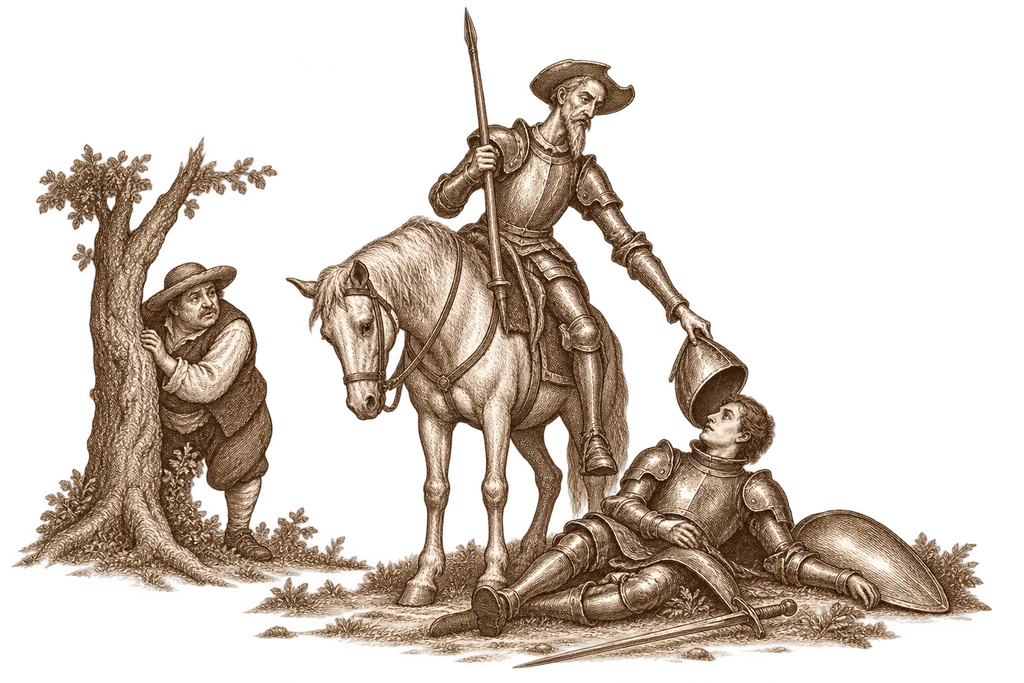
The Knight of the Mirrors claims to have defeated Don Quixote and made him acknowledge Casildea. Don Quixote denies the meeting and accepts a duel. Sancho fears the rival squire's enormous artificial nose and takes refuge in a tree. Trouble with the opponent's horse and Rocinante's movement help Don Quixote unseat his rival. Removing the knight's visor, he recognizes Sansón Carrasco. The other squire identifies himself as their neighbor Tomé Cecial. Don Quixote treats the resemblances as tricks by enchanters and requires the defeated knight to acknowledge Dulcinea's superiority.
What to notice
The narrator identifies practical accidents contributing to the victory. The uncovered faces provide evidence that conflicts with the knight's explanation.
Analysis
The challenge begins with a claim incompatible with Don Quixote’s memory: His opponent insists on having defeated him already. Defending Dulcinea therefore also involves defending the continuity of his own identity. Readers subsequently discover that the other knight’s identity was a performance arranged to intervene in his life. The matching pairs of master and squire result from preparation rather than a chance encounter, and the contest brings that preparation to failure.
Victory does not simply establish superior chivalric ability. The animals’ movements and the moment at which the rival prepares himself contribute to the outcome. Carrasco’s face and Tome Cecial’s identification then offer recognizable evidence capable of exposing the deception. Don Quixote instead places them within an explanation involving enchanters. He can demand recognition of Dulcinea while retaining the adventure’s framework. Sancho has particular reasons for recognizing his neighbor, and the disagreement will persist. Ask what a combatant’s fall actually proves. It determines a winner under the rules they accepted, but does not confirm the motives, identities or earlier claims with which the two men entered the fight. The outcome is decisive physically while remaining disputed as an explanation.
A reflection for today
A successful result can lend authority to a mistaken account of how it happened. The duel encourages us to separate success from the circumstances enabling it, particularly where mistakes and accidents played a part.
Sources and edition
This guide uses Cervantes’s text in Francisco Rodríguez Marín’s La Lectura edition (1911–1913), volume 5, II.14. Verifiable locator: Identifier donquijotedelama05cerv, scan images 249–271 (zero-based digital index). The heading and selected passages were visually checked; the complete notes were not collated. Analysis and present-day reflection are this guide’s commentary.
Read the chapter in English. Read Part 2, Chapter 14 in English in John Ormsby’s translation, via Project Gutenberg. Compare it with the Spanish source cited above; our summary and commentary are separate from the translation.