While the knights compete over love, their squires compare hunger, family and rewards. Sancho recognizes his master's absurdity without ceasing to love him.
On this page
Characters and setting
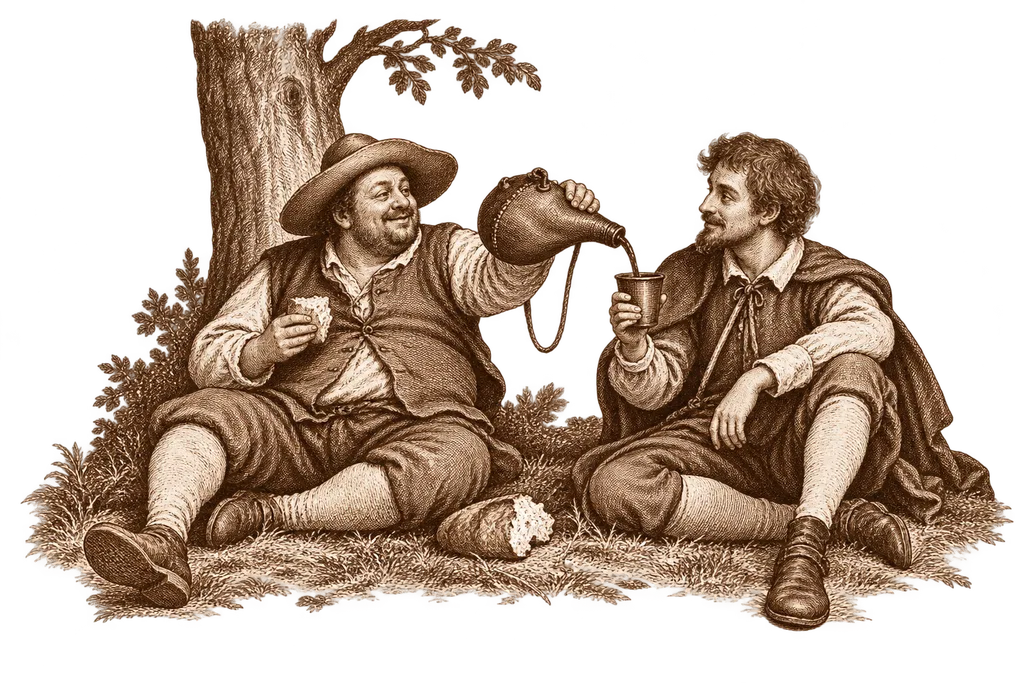
Characters: Sancho and the Knight of the Wood’s squire. Setting: The night-time resting place, where the squires share food and wine.
Summary
Sancho and the other squire discuss the hardships of their work and the rewards they expect. The stranger proposes returning home to raise his children. Sancho describes his hopes of advancement and his affection for Don Quixote despite knowing his madness. An offensive expression about Sancho's daughter prompts a discussion of words the other man says can serve as praise. They then share food and wine. Sancho boasts of recognizing the wine and tells a family story about expert tasters. Both eventually fall asleep beside the wineskin.
What to notice
The other squire hints at his master's purpose: He says that the man acts mad to restore another knight's reason. Sancho also explicitly names the affection keeping him with Don Quixote.
Analysis
The squires test the promised rewards against the fatigue of service. The stranger suggests returning home to raise their children, while Sancho combines hopes of advancement with an affectionate defense of his master. He recognizes the knight’s delusions without considering every reason for serving him exhausted. This matters because continued companionship cannot be explained entirely by ignorance of danger or expectation of wealth. Sancho can value the relationship while acknowledging the difficulties it creates.
The exchange over an insulting expression shows a different difficulty: Claiming that a phrase can serve as praise does not prevent it from hurting its listener. A speaker’s stated intention and another person’s reception still require negotiation. Food and wine then offer a less contentious way to agree. Sancho’s story of the tasters presents him as inheriting an embodied knowledge able to distinguish qualities through taste and smell. That competence differs from the bookish authority through which the knights prepare their challenges. Compare what the squires accept through experience with what depends on promises. Falling asleep beside the wineskin suspends their projects of greatness through an immediate comfort they can share, without proving that those larger expectations have disappeared.
A reflection for today
In casual conversation, understanding a phrase requires attending to its effect as well as its intention. The squires negotiate that meaning over supper; familiarity does not remove the need to explain and listen.
Sources and edition
This guide uses Cervantes’s text in Francisco Rodríguez Marín’s La Lectura edition (1911–1913), volume 5, II.13. Verifiable locator: Identifier donquijotedelama05cerv, scan images 233–248 (zero-based digital index). The heading and selected passages were visually checked; the complete notes were not collated. Analysis and present-day reflection are this guide’s commentary.
Read the chapter in English. Read Part 2, Chapter 13 in English in John Ormsby’s translation, via Project Gutenberg. Compare it with the Spanish source cited above; our summary and commentary are separate from the translation.