A discussion of theater prepares the arrival of another knight playing a role of his own. Don Quixote meets a rival whose story already appears to involve him.
On this page
Characters and setting
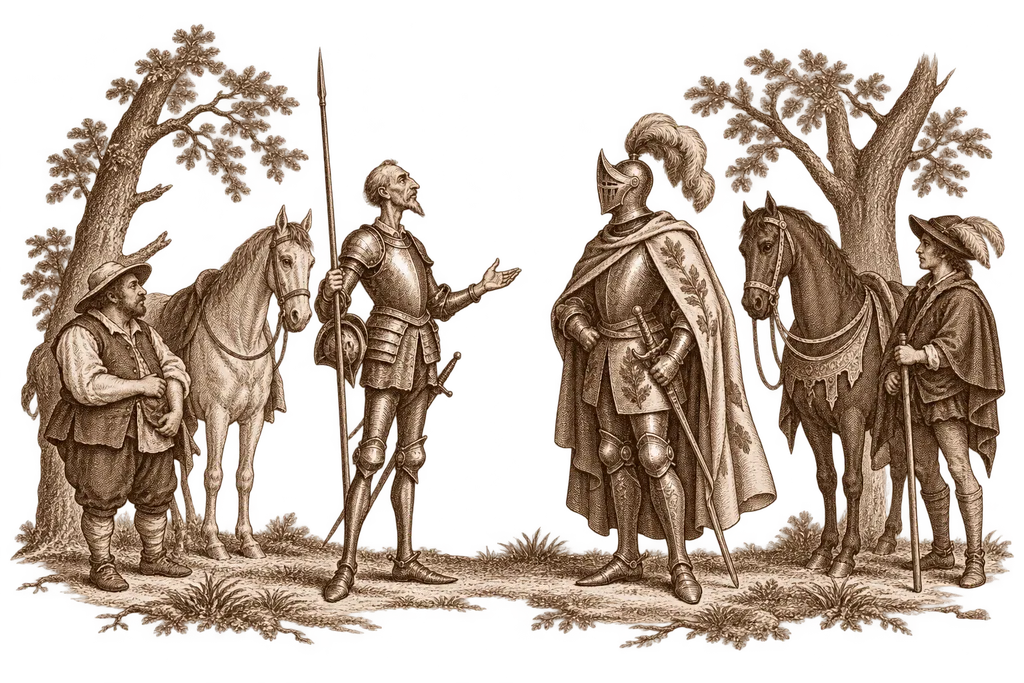
Characters: Don Quixote, Sancho, the Knight of the Wood and his squire. Casildea de Vandalia is the lady invoked by the stranger. Setting: The travelers’ resting place at night.
Summary
Don Quixote compares theatrical roles with the positions people occupy in life, which death eventually makes equal. Sancho contributes the image of chess pieces gathered into one bag. Later that night they hear a knight singing of his love for Casildea de Vandalia. The stranger claims to have made knights of La Mancha acknowledge his lady's superiority. Don Quixote challenges that claim. The knights discuss their loves while their squires withdraw to talk separately.
What to notice
Sancho contributes an image rather than simply receiving a lesson. The separation of the two pairs also shapes the narrative's next sequence.
Analysis
The discussion of roles connects directly with the action: A character immediately appears whose identity will depend on a performance. The chapter delays explaining that role and lets readers observe a rivalry built from the common language of chivalry.
A reflection for today
A professional or social role can guide us while also shaping our expectations of others. The meeting encourages us to hear the story someone uses to introduce themselves without assuming that every credential in it has been established.
Sources and edition
This guide uses Cervantes’s text in Francisco Rodríguez Marín’s La Lectura edition (1911–1913), volume 5, II.12. Verifiable locator: Identifier donquijotedelama05cerv, scan images 217–232 (zero-based digital index). The heading and selected passages were visually checked; the complete notes were not collated. Analysis and present-day reflection are this guide’s commentary.

