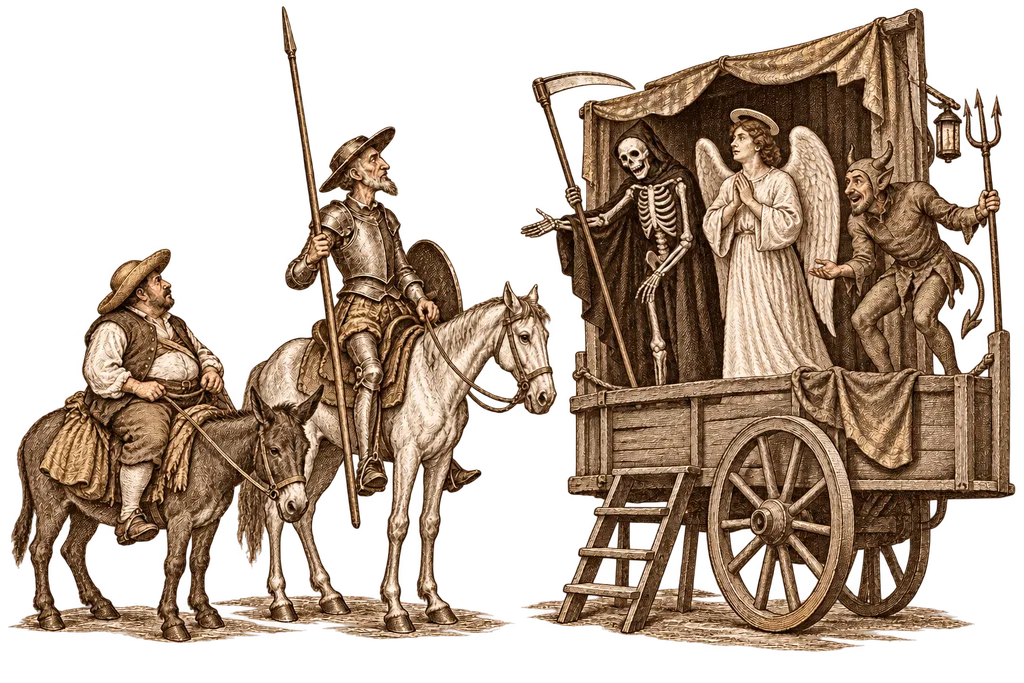
A company of actors crosses the road in theatrical costume. Don Quixote accepts their explanation, although trouble with the animals soon brings him close to violence again.
On this page
Characters and setting
Characters: Don Quixote, Sancho and the actors performing the Courts of Death. Setting: The road traveled by the actors’ cart.
Summary
Don Quixote and Sancho meet a cart carrying figures including Death, an angel and a devil. The passengers explain that they are actors traveling between performances of the Courts of Death. The knight accepts this. One performer plays with his props, frightening Rocinante and throwing Don Quixote. As Sancho helps his master, the actor briefly rides away on Sancho's donkey, which eventually returns. Don Quixote wants to punish the company, and the actors prepare to throw stones. Sancho persuades him that they are not knightly opponents and also declines to seek revenge himself.
What to notice
The costumes have a stated purpose understood by their wearers. Don Quixote does not persist throughout the encounter in treating the actors as supernatural beings.
Analysis
The cart’s figures offer an obvious occasion for misinterpretation, yet Don Quixote accepts the actors’ explanation. Recognizing their profession and costumes allows the encounter to proceed for a time without supernatural danger. This qualifies the idea that the knight transforms everything he sees. Theatrical fiction can identify itself as performance and be understood as such even by this particular spectator.
Conflict begins afterward through a material effect of the entertainment: Bells and inflated bladders frighten Rocinante. The horse needs no chivalric belief to throw his rider. While Sancho assists his master, the incident involving the donkey adds another grievance, and a wish to punish replaces the earlier conversation. The company gathers stones, so retaliation threatens further injury. Sancho invokes the distinction between knights and other opponents to stop Don Quixote, then declines revenge on his own account. A rule of social status that elsewhere obstructs useful intervention now helps prevent a fight. Notice its changed function before assigning the code an identical result in every scene. The chapter separates understanding a performance from managing its physical consequences, and separates receiving an injury from deciding whether another confrontation will remedy it.
A reflection for today
Calling something a joke does not erase its consequences. The episode invites us to consider when to stop retaliation: Sancho assesses what happened and decides that restoring peace matters more than returning the injury.
Sources and edition
This guide uses Cervantes’s text in Francisco Rodríguez Marín’s La Lectura edition (1911–1913), volume 5, II.11. Verifiable locator: Identifier donquijotedelama05cerv, scan images 201–215 (zero-based digital index). The heading and selected passages were visually checked; the complete notes were not collated. Analysis and present-day reflection are this guide’s commentary.
Read the chapter in English. Read Part 2, Chapter 11 in English in John Ormsby’s translation, via Project Gutenberg. Compare it with the Spanish source cited above; our summary and commentary are separate from the translation.