Part 1 ends with another attack, a domestic return and a literary closure that leaves continuation possible. Don Quixote still interprets the world through his mission of rescue.
On this page
Characters and setting
Characters: Don Quixote, Sancho, Eugenio, the penitents, the housekeeper, the niece and Sancho’s wife. Setting: The road where the procession passes, followed by the village to which the travelers return.
Summary
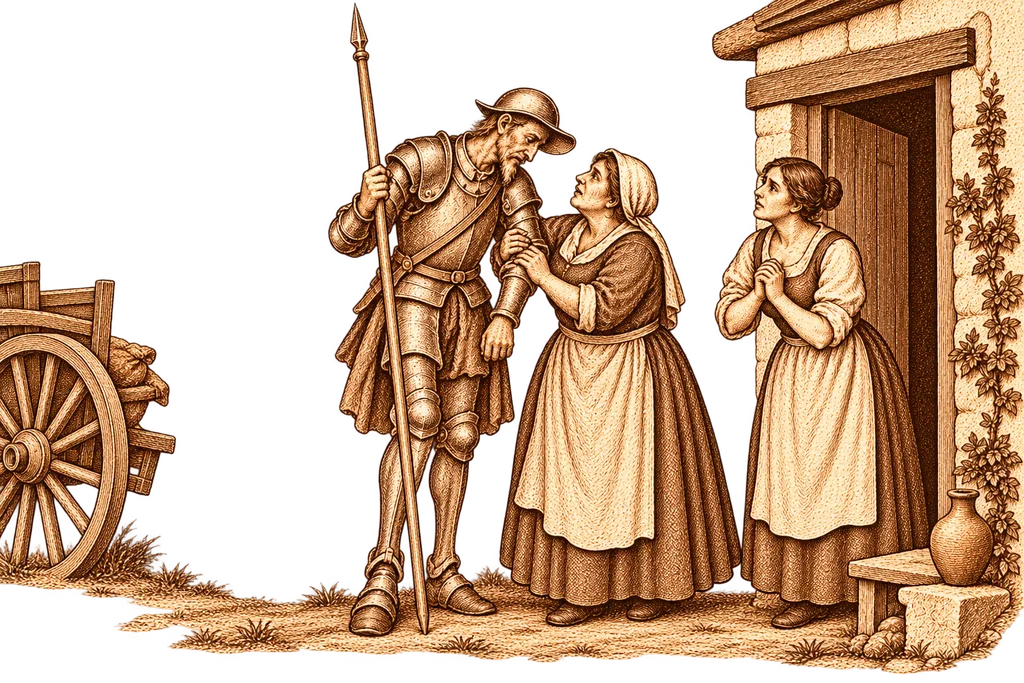
Don Quixote offers to resolve Leandra's predicament; Eugenio mocks his claims, and they fight. A procession of penitents then appears, carrying a religious image and praying for rain. The knight believes a woman is being taken against her will and attacks to free her. He is struck, and Sancho mourns him, thinking him dead. On recovering, he accepts the journey home. His housekeeper and niece receive him in the village; Sancho’s wife asks him what he has gained. The narrator adds uncertain reports and poems attributed to the academicians of Argamasilla.
What to notice
Readers know the procession's purpose and can assess the mistaken rescue. The closing poems and documents belong to the narrative's literary machinery; they do not constitute the protagonist's definitive death in the story's sequence.
Analysis
The ending again tests the wish to help against the interpretation preceding action. Don Quixote offers to remedy Leandra’s situation before establishing what his proposal would involve, and the conversation becomes a fight with Eugenio. Soon afterward, a religious image carried in procession becomes, in his account, a woman being taken against her will. The parallel connects two hasty interventions: His readiness to act displaces inquiry into what is happening and what the people involved actually need.
Sancho tries to stop the second attack and, fearing his master’s death, responds with an affectionate lament. Their bond exceeds the calculation of rewards, although his wife’s questions about profits bring that calculation back when they reach home. The return therefore produces different accounts of the journey, considering both its injuries and its gains. The Argamasilla poems offer a further, literary reckoning between praise and parody. Uncertain reports about future adventures prevent these farewells from becoming a securely documented, closed biography. Notice how the chapter supplies a real homecoming while leaving room for more stories. Finishing an expedition and finishing the character’s narrative are distinct kinds of ending.
A reflection for today
Acting before establishing who needs help can worsen a situation we have misunderstood. The attack on the procession makes observation and questions valuable, particularly when an injustice seems immediately recognizable. This comparison grows from a failed rescue without treating every act of solidarity as suspect.
Sources and edition
This guide uses Cervantes’s text in Francisco Rodríguez Marín’s La Lectura edition (1911–1913), volume 4, I.52. Verifiable locator: Identifier donquijotedelama04cerv, scan images 310–335 (zero-based digital index). The heading and selected passages were visually checked; the complete notes were not collated. Analysis and present-day reflection are this guide’s commentary.
Read the chapter in English. Read Part 1, Chapter 52 in English in John Ormsby’s translation, via Project Gutenberg. Compare it with the Spanish source cited above; our summary and commentary are separate from the translation.