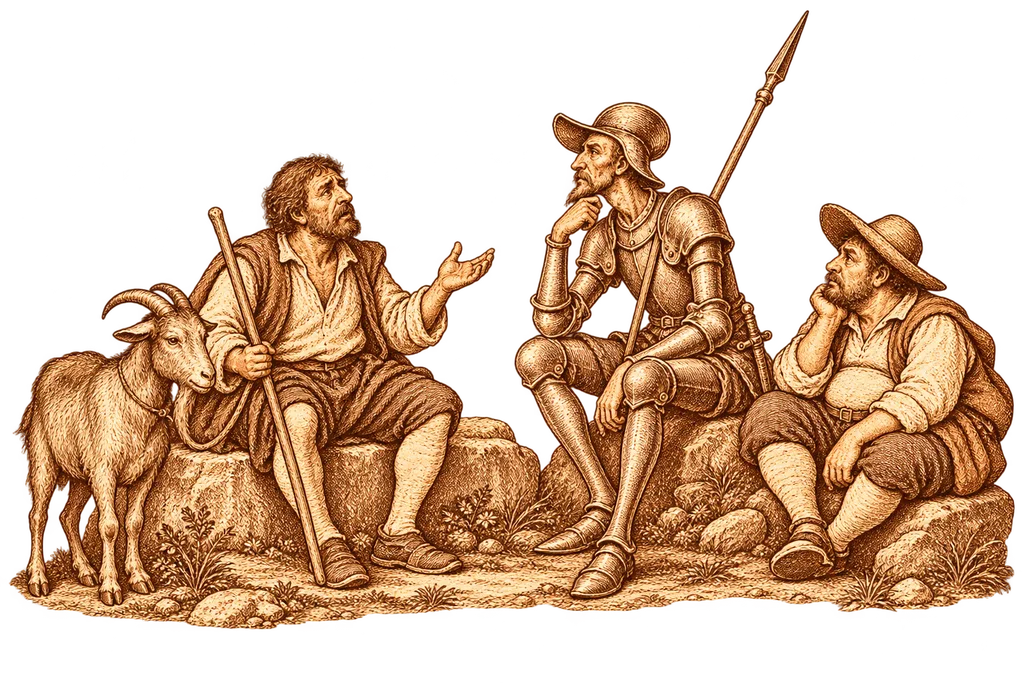
The goatherd Eugenio tells a story in which he is personally involved. Understanding it requires separating reported events from his conclusions about Leandra and women.
On this page
Characters and setting
Characters: Eugenio, who tells the story; Leandra, Anselmo, Vicente de la Roca and Leandra’s father within his account. Setting: The party’s stopping place; the story recalls Leandra’s village and ends with her entry into a convent.
Summary
Eugenio describes Leandra, a young woman admired in her village and courted by both him and Anselmo. She becomes interested in Vicente de la Roca, a soldier who boasts of travels, exploits and elegance. She leaves with him and is later found abandoned, without her jewelry. Leandra explains what happened, and her father places her in a convent. Eugenio and Anselmo, along with other disappointed admirers, take up a pastoral life filled with complaints. Their responses reveal different ways of assigning blame and explaining disappointment.
What to notice
A rejected suitor supplies the account. Leandra's voice reaches readers through his narration, and his personal grievance shapes his broader judgments.
Analysis
Vicente gains credibility through a performed identity: Clothes, stories and manners reinforce his prestige. Eugenio, however, is not a neutral observer. Moving from one incident to a judgment about women shows how a narrator can turn personal disappointment into a collective explanation. Maintaining distance from that judgment is central to reading the story critically.
A reflection for today
After disappointment, generalization can provide a quick explanation while excluding details of the actual situation. Eugenio's voice encourages us to ask what a storyteller knows and what resentment adds. This reflection neither blames Leandra for being deceived nor excuses Vicente's conduct.
Sources and edition
This guide uses Cervantes’s text in Francisco Rodríguez Marín’s La Lectura edition (1911–1913), volume 4, I.51. Verifiable locator: Identifier donquijotedelama04cerv, scan images 296–309 (zero-based digital index). The heading and selected passages were visually checked; the complete notes were not collated. Analysis and present-day reflection are this guide’s commentary.

