Don Quixote answers the canon by making an invented adventure's appeal visible. A goatherd's arrival then shifts the conversation toward another love story.
On this page
Characters and setting
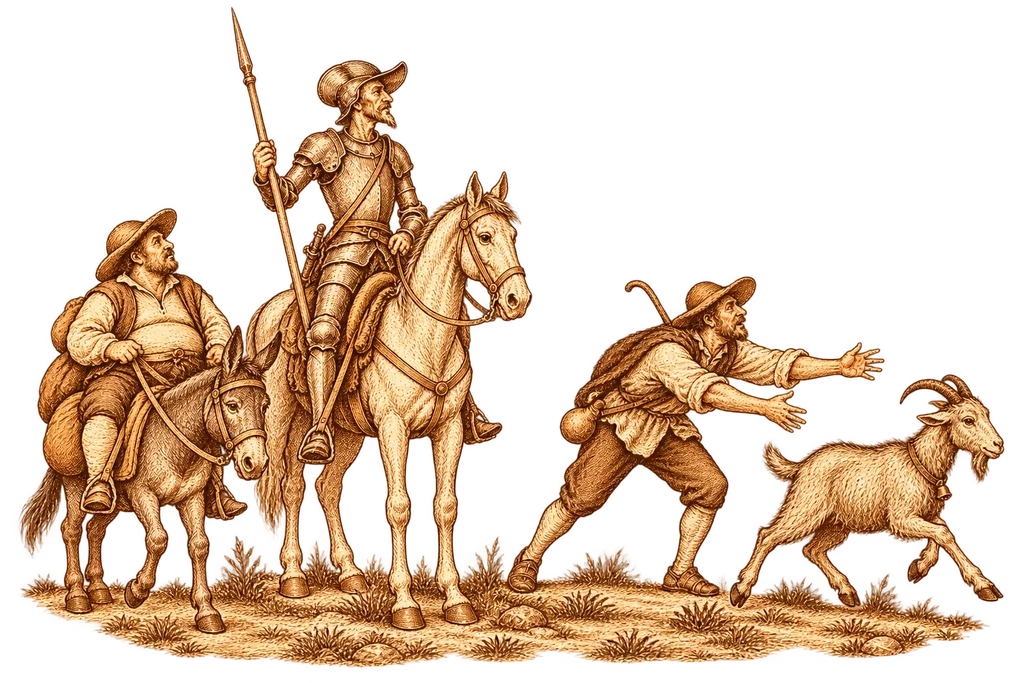
Characters: Don Quixote, Sancho, the canon of Toledo and the goatherd. Setting: The party’s resting place. The lake belongs to the imagined adventure Don Quixote describes.
Summary
Don Quixote appeals to the official approval and widespread readership of romances of chivalry. He enthusiastically describes an extraordinary adventure involving a lake and a marvelous place reached by a knight. He also explains the virtues he attributes to his own wandering life and Sancho's expectations. A goatherd chasing a goat interrupts. He addresses the animal as though it understood him and, at the company's request, prepares to tell the story continued in the next chapter.
What to notice
Rather than relying only on abstract argument, Don Quixote produces a seductive miniature narrative. The goatherd brings in a different voice and a pastoral form of storytelling; the ending prepares his account.
Analysis
The marvelous description allows readers to feel the appeal of the criticized books without accepting their adventures as facts. The defense confuses imaginative value with historical truth, yet it also displays the character's storytelling ability. The pastoral interruption keeps literary debate from exhausting the novel's many ways of telling stories.
A reflection for today
A story can help us imagine possibilities without proving that those events occurred. Preserving that distinction lets us enjoy fiction and evaluate factual claims by a different standard. The knight's speech makes visible the moment when enthusiasm and evidence cease to be interchangeable.
Sources and edition
This guide uses Cervantes’s text in Francisco Rodríguez Marín’s La Lectura edition (1911–1913), volume 4, I.50. Verifiable locator: Identifier donquijotedelama04cerv, scan images 278–294 (zero-based digital index). The heading and selected passages were visually checked; the complete notes were not collated. Analysis and present-day reflection are this guide’s commentary.

