Leaving the cage leads from a question about the body to an argument about the truth of books. Sancho and the canon challenge the knight through different standards.
On this page
Characters and setting
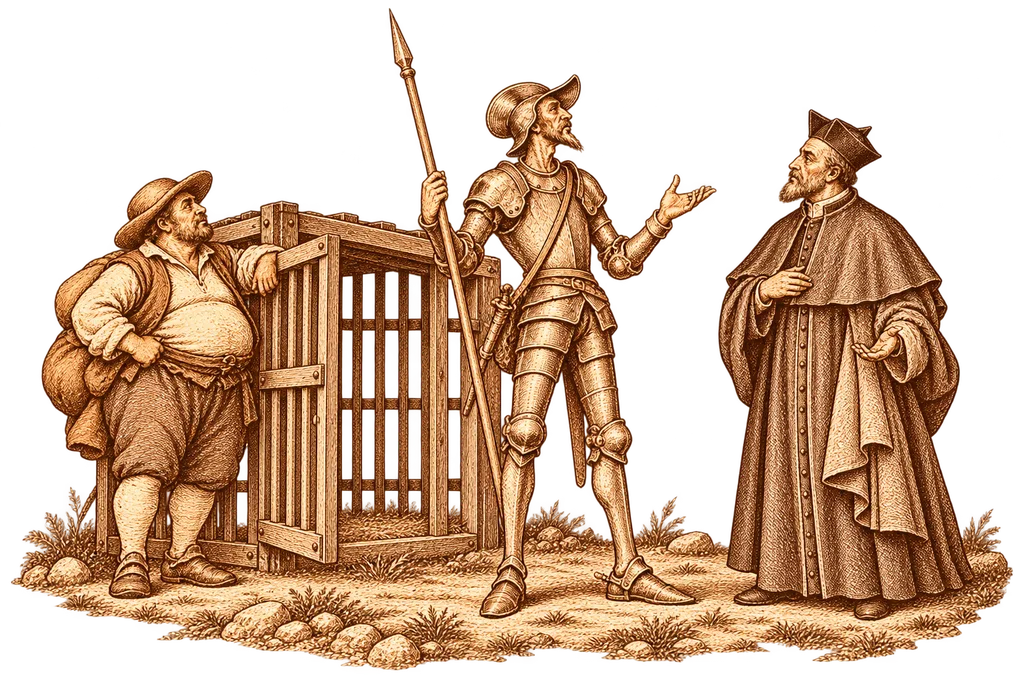
Characters: Don Quixote, Sancho and the canon of Toledo. Setting: The stop on the road home, where Don Quixote is allowed out of the cage.
Summary
Sancho uses Don Quixote's answer about ordinary bodily needs to argue that he is not enchanted. Permission is obtained for the knight to leave the cage, provided he promises not to escape. The canon speaks to him directly and urges him to abandon romances of chivalry, blaming them for his condition. Don Quixote defends the deeds and characters he knows from his reading. Their controversy brings together histories, traditions and narratives that the speakers do not evaluate in the same way.
What to notice
Sancho seeks a test available in the present. Don Quixote accumulates examples inherited from texts and stories. The historical and legendary names he cites do not all provide equivalent kinds of evidence.
Analysis
Adding authorities cannot settle a disagreement about how authority should be accepted. Don Quixote treats a story's circulation as a sign of truth; the canon challenges the credibility of those stories themselves. Their exchange shows how arguments may pass each other without addressing the other speaker's underlying standard.
A reflection for today
Before debating a conclusion, agreeing on what would count as evidence can be useful, including what would make us revise our view. This conversation exposes a limit in arguments whose participants defend different standards. That is a present-day application of the episode, rather than an explicit rule of debate stated by Cervantes.
Sources and edition
This guide uses Cervantes’s text in Francisco Rodríguez Marín’s La Lectura edition (1911–1913), volume 4, I.49. Verifiable locator: Identifier donquijotedelama04cerv, scan images 258–276 (zero-based digital index). The heading and selected passages were visually checked; the complete notes were not collated. Analysis and present-day reflection are this guide’s commentary.

