An argument over two objects grows into a collective fight. Separate stories at the inn become a dispute in which everyone must negotiate what counts as true.
On this page
Characters and setting
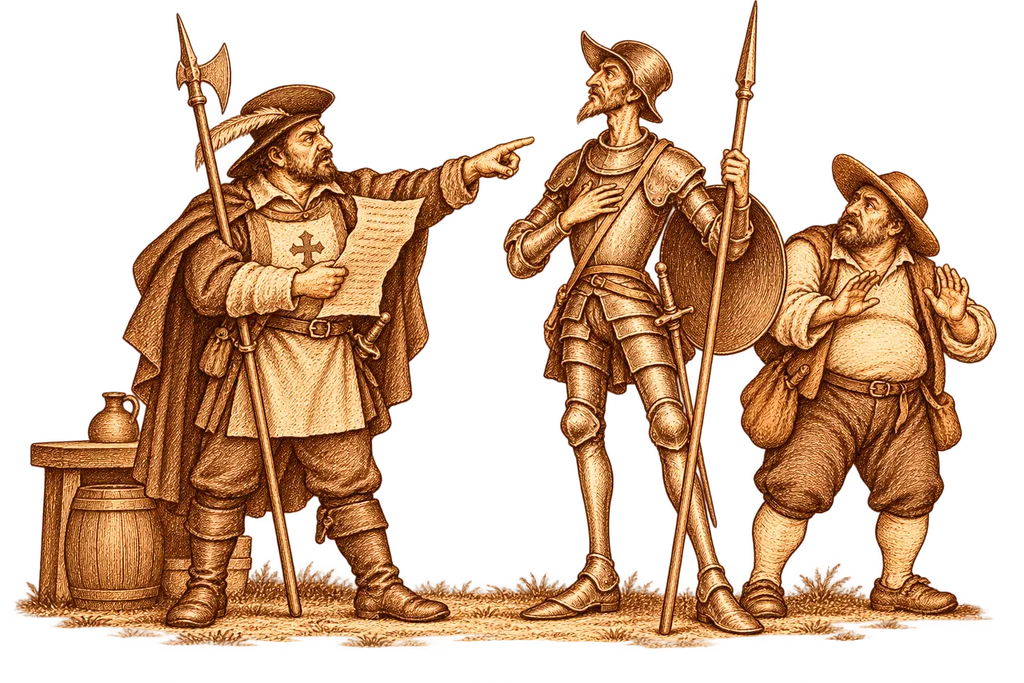
Characters: Don Quixote, Sancho, the barber claiming his basin, the guests and the officers of the Holy Brotherhood. Setting: The inn, where the argument over the objects turns into a fight.
Summary
The barber demands recognition of his basin and pack saddle. Several guests, familiar with Don Quixote's fantasies, jokingly support their transformation into knightly equipment. Others resist, and the argument turns into a brawl. Don Quixote compares the confusion to Agramante's camp. As peace begins to look possible, an officer of the Holy Brotherhood recognizes the knight in a warrant connected with the freed galley prisoners. What began as an argument now has legal consequences.
What to notice
The shared claim that the basin is a helmet comes from a joke, rather than an investigation. The warrant links this scene to the galley-prisoner episode and restores consequences to an action Don Quixote regarded as righteous.
Analysis
Agreement can arise from complicity and amusement. For the barber, the game undermines recognition of his property. The movement from words to an officer's intervention prevents the inn from becoming a consequence-free fantasy: Possessions, damage and past actions retain meanings outside the knight's vocabulary.
A reflection for today
A room full of people repeating the same account does not necessarily provide independent evidence. In an online discussion, we can distinguish people who have checked a claim from people extending a joke. The inn makes that distinction worth considering without treating its dispute as a historical equivalent of today's social media.
Sources and edition
This guide uses Cervantes’s text in Francisco Rodríguez Marín’s La Lectura edition (1911–1913), volume 4, I.45. Verifiable locator: Identifier donquijotedelama04cerv, scan images 172–191 (zero-based digital index). The heading and selected passages were visually checked; the complete notes were not collated. Analysis and present-day reflection are this guide’s commentary.

