Daybreak brings apparently separate disputes together at the inn: Clara's love, the innkeeper's business and ownership of Don Quixote's supposed spoils.
On this page
Characters and setting
Characters: Don Quixote, Sancho, Maritornes, Don Luis, the judge, the servants of Don Luis’s father, the innkeeper and the barber claiming his belongings. Setting: The inn at daybreak.
Summary
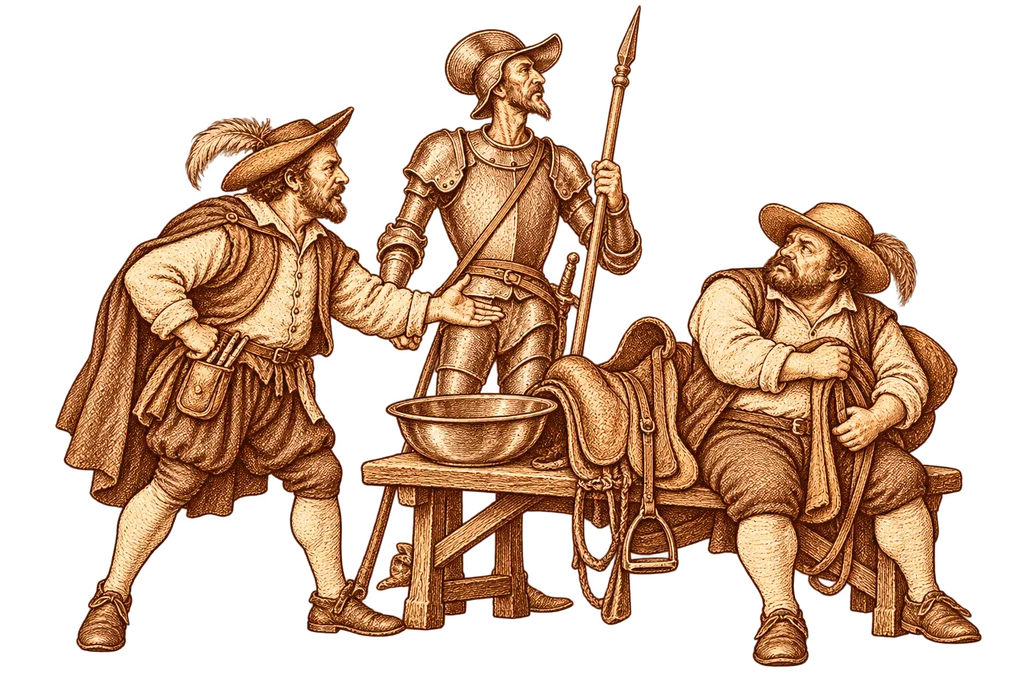
Maritornes releases Don Quixote, who falls and then challenges anyone questioning his predicament. The newcomers are servants of Don Luis's father, sent to take him home. The young man tells Clara's father, the judge, that he loves her and seeks his consent. Meanwhile, two guests try to leave without paying and beat the innkeeper. Don Quixote delays helping because of his knightly rules; persuasion eventually settles the dispute. The barber whose basin and donkey equipment were taken then arrives. He recognizes his belongings and confronts Sancho.
What to notice
The narrator moves openly between groups, keeping several problems unresolved. Sancho's word baciyelmo combines the ordinary basin with the helmet claimed by his master.
Analysis
The inn brings together problems requiring more particular responses than a heroic adventure can provide. Maritornes releases the halter, removing the physical evidence of the prank, while Don Quixote retains his extraordinary explanation. Freeing his body does not make him reconsider what happened. Luis faces a different change: The servants’ arrival turns a secretly pursued attachment into a request that must be discussed with Clara’s father and, eventually, with his own family.
The attack on the innkeeper exposes a practical limit within the knight’s rules. Don Quixote sees someone being beaten but delays helping because the assailants do not belong to the social category he considers appropriate opponents. His code classifies the people before responding to their immediate situation. The barber’s arrival then introduces a property claim: What the knight keeps as a helmet remains an object its owner recognizes as a basin. Love, debt and possession therefore require different kinds of judgment. Notice which disputes move forward through conversation and which become harder when one participant imposes a description others reject. The chapter connects these conflicts without pretending that a single chivalric rule can settle all of them.
A reflection for today
Within a team, a useful rule can become a reason to postpone a problem that nobody takes responsibility for. The innkeeper's predicament invites us to judge a procedure by its effects on someone needing help. This reading does not reject every rule; it examines a specific moment when classification displaces responsibility.
Sources and edition
This guide uses Cervantes’s text in Francisco Rodríguez Marín’s La Lectura edition (1911–1913), volume 4, I.44. Verifiable locator: Identifier donquijotedelama04cerv, scan images 150–170 (zero-based digital index). The heading and selected passages were visually checked; the complete notes were not collated. Analysis and present-day reflection are this guide’s commentary.
Read the chapter in English. Read Part 1, Chapter 44 in English in John Ormsby’s translation, via Project Gutenberg. Compare it with the Spanish source cited above; our summary and commentary are separate from the translation.