At the inn, a song reveals a love story while Don Quixote's knightly watch ends in a trap. The chapter places two ways of interpreting a romantic signal side by side.
On this page
Characters and setting
Characters: Don Quixote, Dorotea, Doña Clara, Don Luis, Maritornes and the innkeeper’s daughter. Setting: The inn; the trick takes place by the opening in the hayloft.
Summary
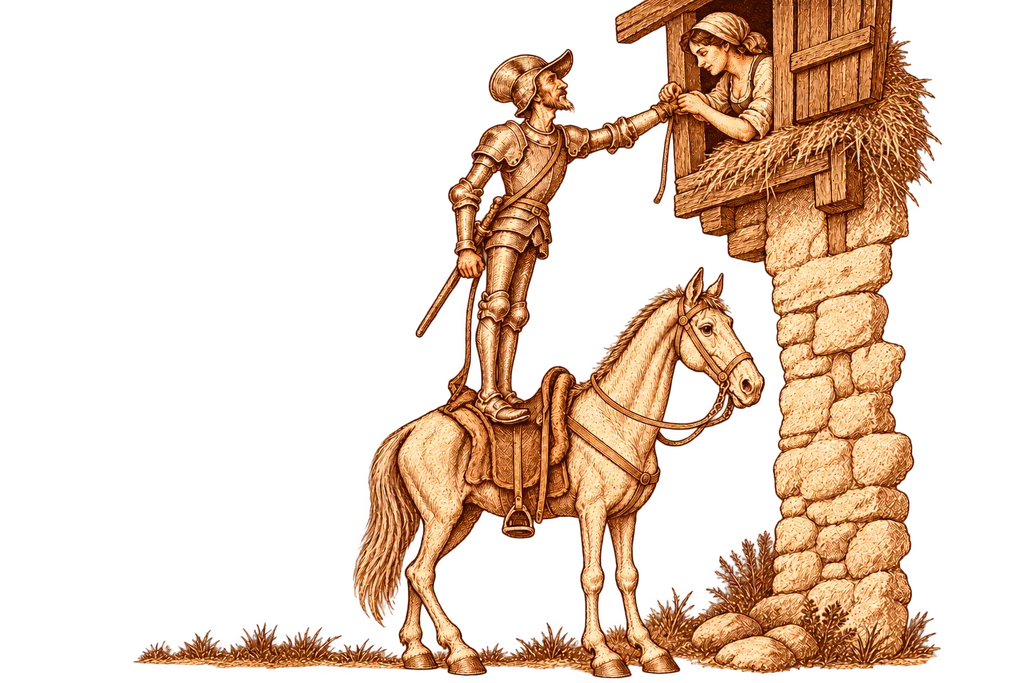
Dorotea wakes Doña Clara to hear the supposed mule driver's song. Clara recognizes the young man who loves her and explains that he is the son of a wealthy gentleman. He has followed her in disguise, while her father does not know why. Dorotea offers to help. Outside, Maritornes and the innkeeper's daughter call Don Quixote to an opening in the hayloft. He imagines a declaration of love and offers his hand; Maritornes ties his wrist. When Rocinante moves at dawn, the knight is left painfully hanging.
What to notice
The same song means different things to its listeners: Dorotea admires the voice, while Clara recognizes a person. Readers also see the practical preparation of a trick that Don Quixote will explain as enchantment.
Analysis
The paired scenes distinguish real attachment from fantasy without dismissing every experience of love. Clara fears specific family obstacles; Don Quixote fits an ambiguous request into his familiar model of a castle and a maiden. Unequal knowledge creates the comedy, but the injured wrist gives the verbal game a bodily cost.
A reflection for today
An isolated signal can look like confirmation when we already want a particular answer. Maritornes's trick encourages us to ask who is speaking, what they know and what they want before filling the gaps with our hopes. This is a present-day interpretation of the scene, rather than a psychological theory attributed to Cervantes.
Sources and edition
This guide uses Cervantes’s text in Francisco Rodríguez Marín’s La Lectura edition (1911–1913), volume 4, I.43. Verifiable locator: Identifier donquijotedelama04cerv, scan images 124–148 (zero-based digital index). The heading and selected passages were visually checked; the complete notes were not collated. Analysis and present-day reflection are this guide’s commentary.

