
The captive recounts leaving home, his military career and the loss of his freedom. A private life passes through the wars of the Mediterranean.
On this page
Chapter summary
The storyteller comes from the mountains of León. Aware of his excessive spending, his father divides his property and proposes different careers for his three sons. The eldest chooses soldiering; another sets out for the Indies, and the youngest continues his studies in Salamanca. Before parting, the sons return some of their money to their father.
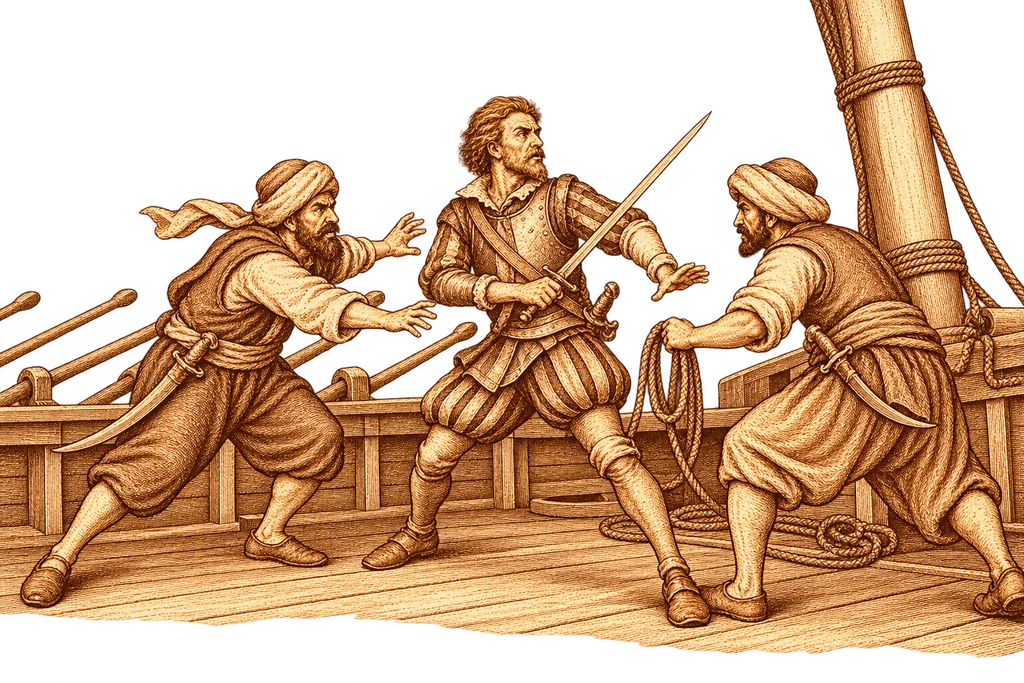
The future captive travels through Italy, serves in Flanders and fights as a captain at Lepanto. During a boarding action he becomes isolated aboard an enemy galley and is captured by Uchalí’s men. He then recounts campaigns experienced as a captive and galley rower, including the fall of La Goleta and the fortress at Tunis. He remembers Pedro de Aguilar, a fellow prisoner who wrote two sonnets. One of the listeners proves to be Aguilar’s brother and confirms that he returned home, married and has children.
Characters and relationships
The father tries to arrange his sons’ futures, but their affection changes the distribution of wealth: They do not want to leave him without support. Their separation begins different journeys whose outcomes remain unknown to the captive after many years without news.
Uchalí becomes the prisoner’s master within the account of war. Pedro de Aguilar connects military experience with poetry. His brother’s intervention brings the story back to the inn and supplies an outcome the captive did not know.
Narrative technique and language
First-person narration turns the general discussion of soldiers into a particular life. Places, commanders and campaigns give the account the shape of testimony, although it remains a story within a novel.
Collective victory intersects with individual defeat: The day celebrated by many ends in chains for the speaker. His defence of La Goleta’s soldiers also challenges people who judge a defeat from a distance. Meeting Aguilar’s brother interrupts the historical account with personal news.
A reflection on the chapter
Public and private fortunes can move in opposite directions. One battle yields both victory and captivity, and military fame does not guarantee protection for the individual. The final relief comes from no new conquest, but from learning that a companion regained his freedom. That personal scale changes what a successful outcome means.
What to remember
The captive narrates a story within the novel. He should not simply be identified with Cervantes, or every event he describes treated as part of the author’s biography. His return and his connection with Zoraida have yet to be explained.
Source and reading
Cervantes’s text in Rodríguez Marín’s La Lectura edition (1911–1913), volume 4. Checked passages: P. 9, p. 10, p. 11, p. 15, p. 16, p. 20, p. 22, p. 25, p. 26. Original summary, analysis, and reflection by QuixoteGuide.


