The captive’s account moves from military campaigns to preparations for escape. Zoraida’s initiative and an interpreter’s help turn signals and letters into a prospect of freedom.
On this page
Chapter summary
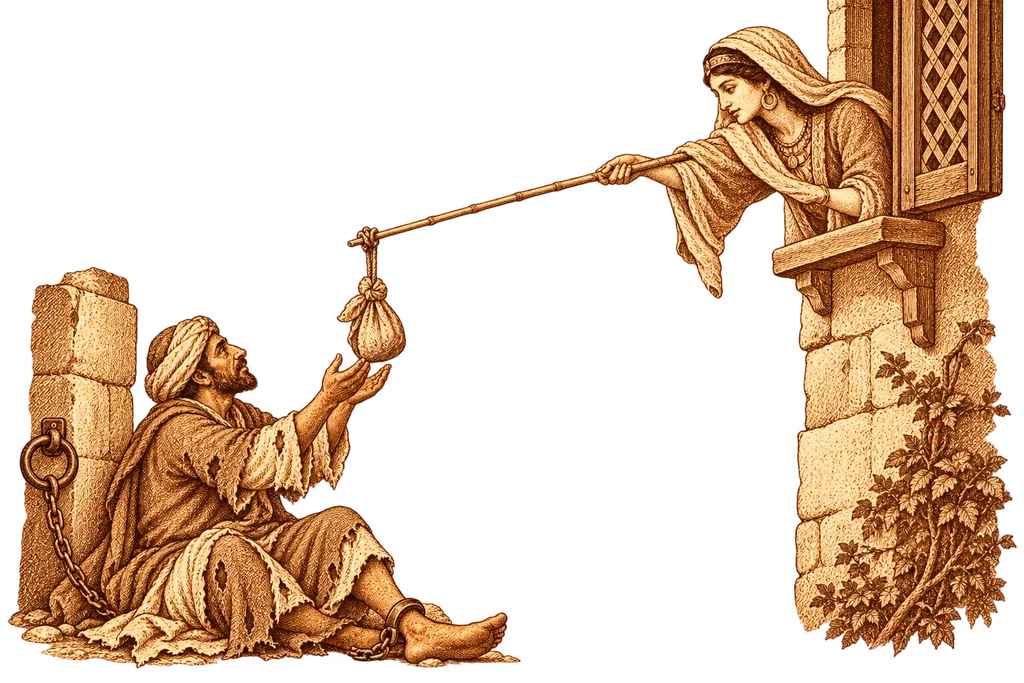
After Pedro de Aguilar’s sonnets, the captive resumes his story. When Uchalí dies, he passes into Azán Agá’s ownership and reaches Algiers. He is held in a baño, a prison for captives in this context. From a neighbouring window he receives money lowered on a reed, followed by a letter in Arabic.
A renegade from Murcia translates it. The writer is Zoraida, daughter of the wealthy Agi Morato. A Christian enslaved woman had taught her prayers and devotion to Mary; she wants to leave for Spain and offers money to make this possible. The captive promises to marry her. The interpreter joins the plan and proposes buying a boat in Algiers under cover of a trading venture. Zoraida’s money pays for the captive and his three companions to be ransomed. Their departure with her is still to come.
Characters and relationships
Zoraida chooses the recipient of her messages, explains her wishes and provides the crucial funds. Her father knows nothing of the project, and she fears his reaction to its discovery. The captive must respond to a wish he cannot understand without translation.
The renegade hopes to return to the Church and acts as interpreter and organizer. The captives accept his help without entirely losing their fear of betrayal. A Valencian merchant arranges the ransoms without knowing the escape plan.
Narrative technique and language
The reed, the hand, the cross and bundles of money form a language of signs before a readable letter arrives. The captives’ first guesses prove wrong; translation allows them to correct their interpretation.
Inserted letters give Zoraida a voice within the captive’s account. Preparations involve money, guarantees and practical precautions. Trust is also questioned: The interpreter recalls captives who gained freedom but failed to return for their companions.
A reflection on the chapter
The captive’s reply boasts of Christian fidelity, but the interpreter’s experience complicates that confidence. Membership of a group does not guarantee that someone will keep a promise. The plan needs demonstrable actions, shared resources and commitments that survive the first personal benefit. Zoraida also directs her own departure rather than awaiting a rescue imagined entirely by others.
What to remember
The baño is a prison, and ransom means payment for the captive’s release. Release does not yet mean departure from Algiers. The sea escape and the parting from Zoraida’s father follow in the next chapter.
Source and reading
Cervantes’s text in Rodríguez Marín’s La Lectura edition (1911–1913), volume 4. Checked passages: P. 35, p. 36, p. 42, p. 46, p. 47, p. 49, p. 51, p. 52, p. 53. Original summary, analysis, and reflection by QuixoteGuide.


