Don Quixote continues the speech begun in the previous chapter. His defence of the soldier combines attention to hardship with fear of weapons that challenge his chivalric ideal.
On this page
Chapter summary
Don Quixote describes the soldier’s poverty, uncertain pay and constant risk of death or injury. Unlike the student’s prospect of a professional appointment, the fighting man may survive many battles without escaping hardship.
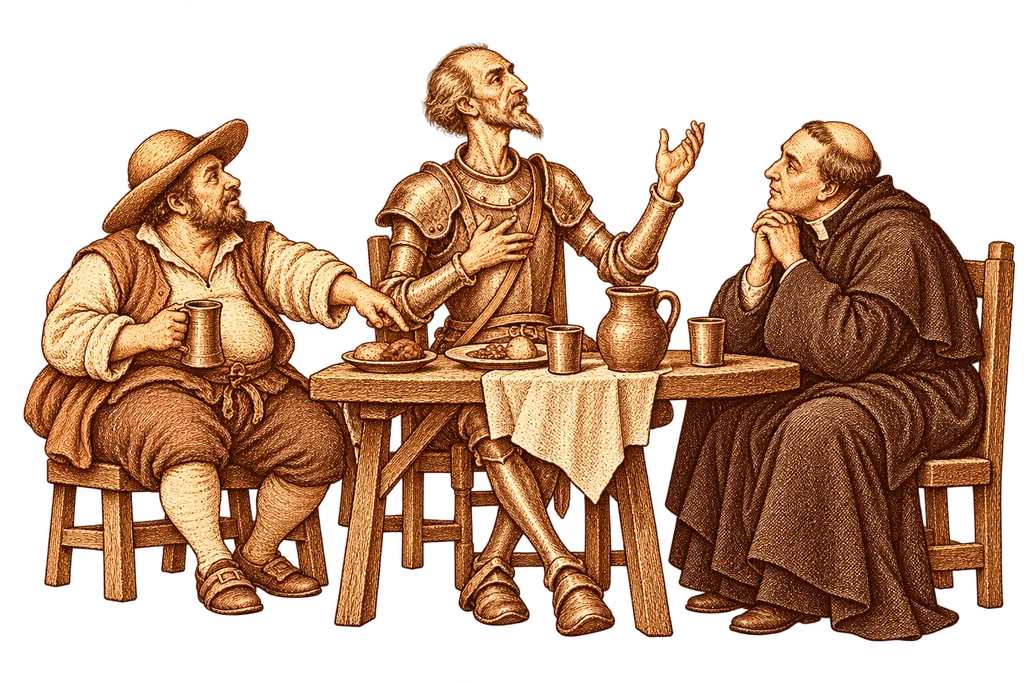
He then presents arguments on both sides: Warfare needs laws, but arms protect states and make law enforceable. He evokes the danger of mines during a siege and of boarding an enemy galley. He condemns artillery because a bullet can kill a brave man without allowing him to prove his skill. While he speaks, the others eat and Sancho urges him to join them. After supper, the gathering asks the captive to tell his story.
Characters and relationships
Don Quixote speaks with sustained reasoning about a particular subject. The priest, despite belonging to the learned professions, supports his defence of arms. The listeners pity the contrast between his intelligence and his obsession with knight-errantry.
Sancho again attends to an immediate need: Food. The captive agrees to speak and promises a true account that may surpass literary invention in its extraordinary events.
Narrative technique and language
Comparisons, rhetorical questions and scenes of physical danger structure the argument. The ceremony of receiving an academic degree becomes, through irony, the soldier’s injury and the bandages used to treat it.
The narrator returns the speech to the supper table. This setting prevents Don Quixote from becoming an isolated doctrinal voice: His eloquence accompanies distraction and his personal ambition for fame. The ending prepares a shift from general reasoning to the captive’s testimony.
A reflection on the chapter
The complaint about soldiers’ meagre rewards directs attention to the human cost behind honour. Yet Don Quixote’s objection to artillery also comes from his wish to measure merit through individual courage. We can take the suffering he describes seriously while asking whether his ideal of glory can understand warfare that no longer follows the rules of his books.
What to remember
These are the character’s arguments, rather than an automatically definitive statement of the author’s views. The captive’s narrative starts in the next chapter; this one prepares the audience to listen.
Source and reading
Cervantes’s text in Rodríguez Marín’s La Lectura edition (1911–1913), volume 3. Checked passages: P. 327, p. 328, p. 331, p. 332, p. 333, p. 335. Original summary, analysis, and reflection by QuixoteGuide.


