Dorotea improvises a chivalric story, while the prospect of a kingdom starts another argument between Don Quixote and Sancho.
On this page
Summary
Sancho reveals that his master freed the galley prisoners. Don Quixote defends his duty to help the afflicted, and Dorotea calms him by recalling his promise to Micomicona.
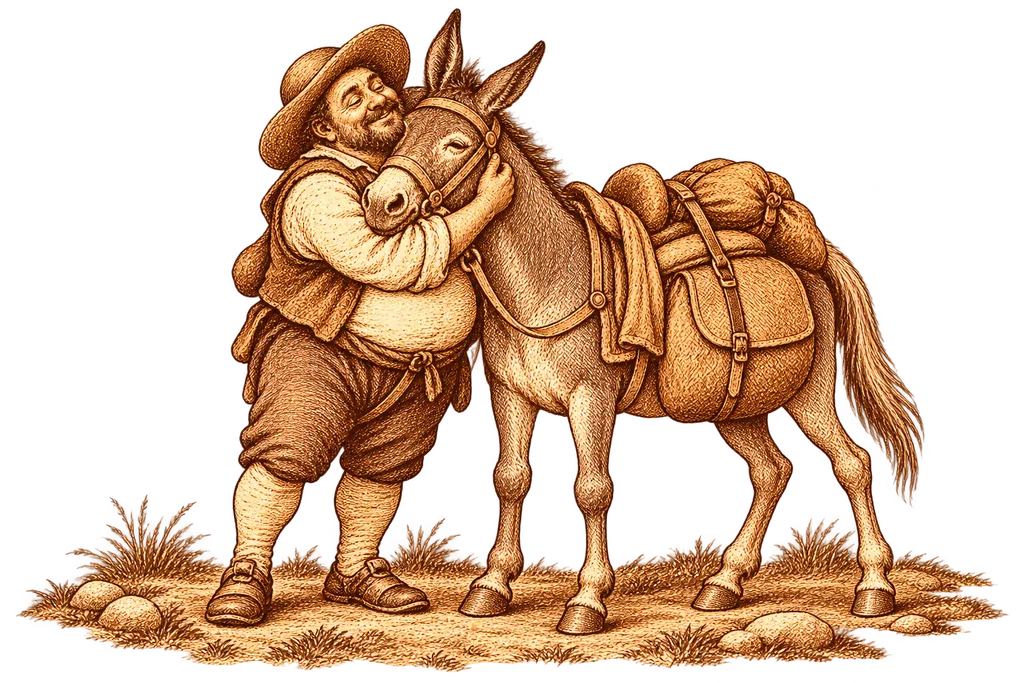
Dorotea invents a prophecy and the giant Pandafilando of the Scowling Eye. The priest repairs her forgotten details and her impossible landing at inland Osuna. Sancho urges Don Quixote to marry her so that he can receive rewards. When he disparages Dulcinea, his master beats him until Dorotea intervenes. Sancho later recognizes Ginés de Pasamonte riding his donkey and recovers the animal. Asked about his supposed mission to Dulcinea, he admits leaving without the letter but supplies another invented explanation.
Characters and relationships
Dorotea and the priest cooperate as actor and prompter. Sancho both believes the princess’s fiction and maintains his own deception. Don Quixote’s ideal loyalty to Dulcinea clashes with his squire’s calculations.
Humor, language, and narration
Micomicona’s history is assembled in front of people who know the deception. Dorotea hesitates over the hero’s name, places a disembarkation at Osuna and offers a bodily identifying mark with an uncertain location. The priest and others help resolve the difficulties. Credibility rests less on a flawless account than on a shared willingness to fit the details to a desired outcome.
The prophecy assigns Don Quixote in advance the role the performer needs him to accept. He can recognize himself as the protagonist and treat uncertainties as minor questions. Readers, however, have watched the account being adjusted. This difference lets us enjoy the device without treating information invented by the characters as reliable facts about the novel’s world.
Sancho concentrates on a marriage that could make his master a king and advance his own position. Comparing the princess favorably with Dulcinea provokes a violent response, bringing actual pain into a conversation about invented kingdoms. The later reconciliation does not erase that inequality. The scene connects the squire’s interest, his master’s proclaimed fidelity and the power of the latter to punish an objection. Notice who can repair the relationship and on whose terms.
Reading reflection
Don Quixote defends helping strangers because they suffer, yet loses restraint when his ideal beloved is verbally slighted. Compassion and violence coexist, requiring separate judgments of his actions. Declaring a good intention does not remove responsibility for hurting his companion.
A note on this edition
La Lectura places the donkey’s recovery here. This guide follows that passage in the selected edition and distinguishes Sancho’s invented mission from an actual visit to Dulcinea.
Source and reading
Cervantes’s text in Rodríguez Marín’s La Lectura edition (1911–1913), volume 3. Checked passages: P. 109, p. 115, p. 120, p. 126, p. 129. Original summary, analysis, and reflection by QuixoteGuide.
Read the chapter in English. Read Part 1, Chapter 30 in English in John Ormsby’s translation, via Project Gutenberg. Compare it with the Spanish source cited above; our summary and commentary are separate from the translation.