Retreat opens a new mystery. Abandoned belongings introduce a person before he tells his own story.
On this page
Summary
Sancho persuades Don Quixote to enter Sierra Morena to avoid the Holy Brotherhood. The La Lectura edition places here Ginés de Pasamonte’s theft of Sancho’s donkey and the knight’s promise of compensation.
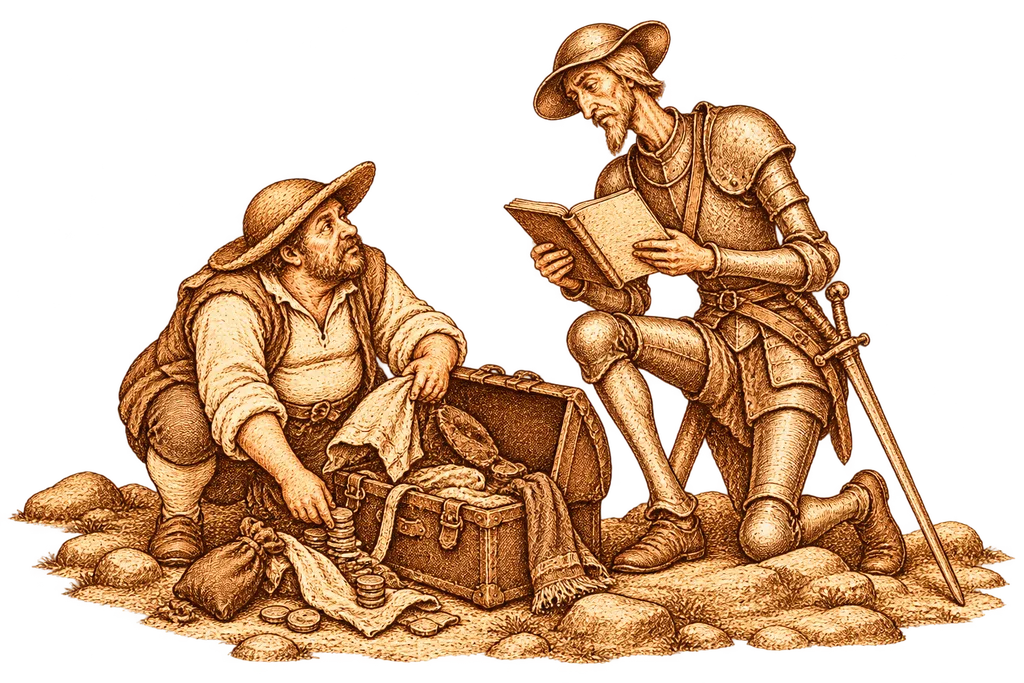
They find a bag containing money, fine clothes and a notebook of poems and love letters. Sancho welcomes the gain; Don Quixote tries to identify its owner. They see a ragged man running through the hills. A goatherd explains that he alternates courteous behavior and attacks and blames someone named Fernando. The goatherd and other herdsmen want to help him. The young man finally appears, and Don Quixote embraces him.
Characters and relationships
Sancho wants to retain the money; Don Quixote insists on finding the possible owner and returning it. The goatherd contributes local knowledge and concern for the isolated man. The stranger has not yet narrated his life himself.
Narrative techniques
The stranger’s appearance is prepared through clues that do not yet form a complete explanation. A damaged suitcase contains carefully kept clothing, money and writings. Together they suggest a break between an earlier life and the present situation, but objects do not explain that break by themselves. The sonnet expresses pain without supplying an unambiguous account of its cause.
Don Quixote and Sancho inspect these materials with different interests. One reads the notebook and tries to reconstruct a story; the other searches seams and corners for additional money. For Sancho, the discovery can compensate for the journey’s suffering. His assessment changes even though the remembered beatings have not disappeared. A reward reorganizes his balance of past experiences.
A figure glimpsed among the rocks and the goatherd’s testimony add a body and behavior to the writings. The witness knows alternating friendliness and violence but cannot provide the complete account either. When the two men finally meet, their battered appearances allow an approach before an explanation. The chapter distinguishes examining traces, hearing a witness and making room for the sufferer’s own voice. Each step offers a different kind of information.
Humor, language and narrator
While Don Quixote examines the notebook, Sancho searches the bag. Literary and material interests are not absolute opposites: The knight also states a practical duty to return the property.
Reflection
Avoiding the search for an owner makes keeping the money easier. Don Quixote rejects that convenience once clues exist. Deliberately ignoring relevant information does not turn a personal advantage into a just claim.
Source and reading
Cervantes’s text in Rodríguez Marín’s La Lectura edition (1911–1913), volume 2. Checked passages: P. 236, p. 239, p. 247, p. 252. Original summary, analysis, and reflection by QuixoteGuide.
Read the chapter in English. Read Part 1, Chapter 23 in English in John Ormsby’s translation, via Project Gutenberg. Compare it with the Spanish source cited above; our summary and commentary are separate from the translation.