A barber’s basin lets Don Quixote announce a victory. Master and squire then build a shared future of honors.
On this page
Summary
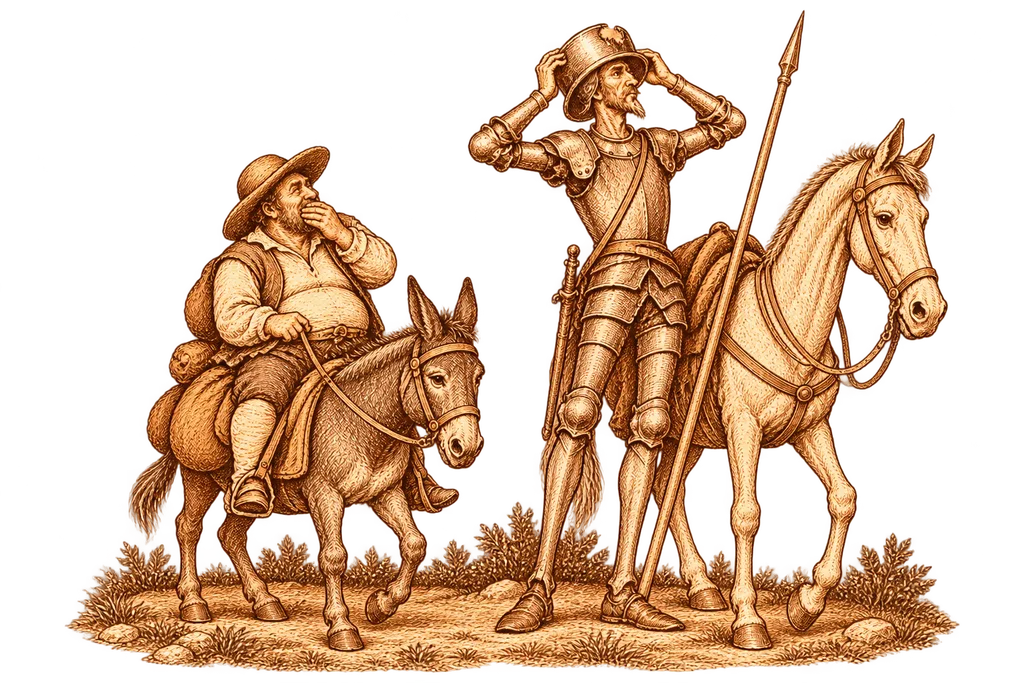
In the rain, a barber protects his hat with a metal basin. Don Quixote mistakes it for Mambrino’s helmet and charges him. The barber escapes, abandoning the basin, which the knight wears despite its poor fit. Sancho recognizes it and suppresses his laughter.
Don Quixote prevents Sancho from taking the barber’s donkey but permits an exchange of equipment. Later, Sancho suggests serving a prince to obtain rewards and witnesses to their deeds. His master describes an ideal sequence: Fame, reception at court, a princess’s love, victories and a kingdom. Sancho imagines becoming a count. They discuss the knight’s uncertain royal ancestry and possible ways around the difficulty.
Characters and relationships
The barber is a working man surprised by an attack. Sancho sees the object more clearly but shares the desire to prosper. Don Quixote moves from interpreting what he sees to designing their future.
Narrative techniques
The narrator supplies the ordinary explanation before unfolding the imagined victory. The second half introduces a hypothetical story that the knight treats as a possible route through life.
Humor, language and narrator
The basin’s failure to fit like a helmet prompts fresh explanations. Their courtly dream combines romance conventions with practical questions of titles, reward and appearance.
Reflection
Sancho can disagree about a basin while believing the future his master promises. Clear sight of an object does not guarantee distance from a personal hope. His participation invites us to examine the promises we want so much that we stop questioning their conditions.
Source and reading
Cervantes’s text in Rodríguez Marín’s La Lectura edition (1911–1913), volume 2. Checked passages: P. 165, p. 173, p. 186, p. 190. Original summary, analysis, and reflection by QuixoteGuide.


