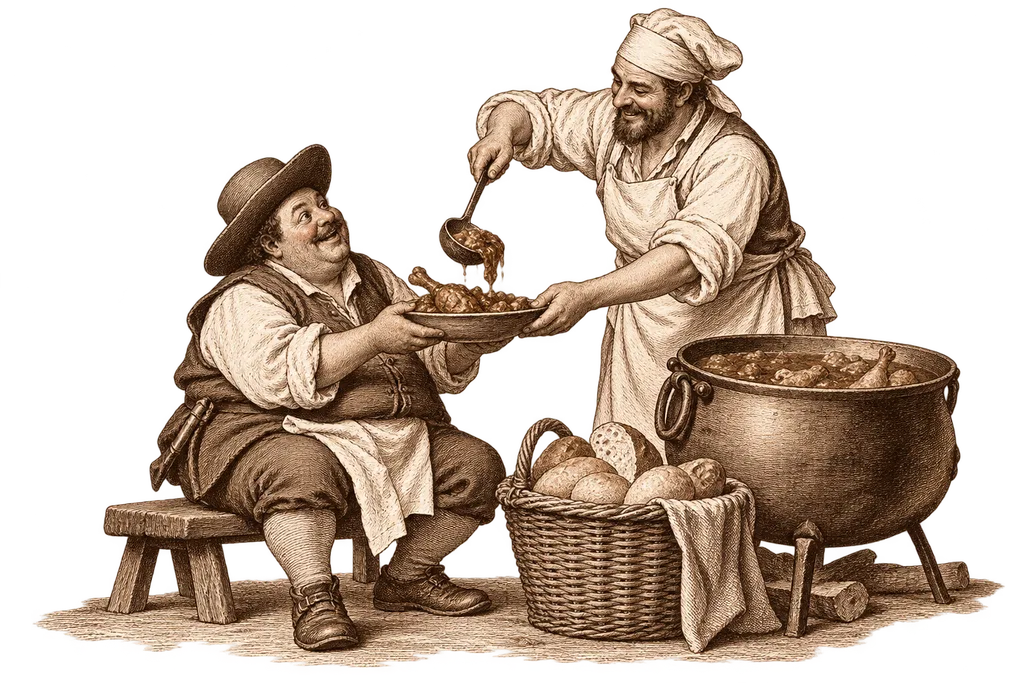
Camacho's wealth becomes plentiful food and public spectacle. Sancho watches the cooking pots while Don Quixote reads a performance of the lovers' conflict.
On this page
Characters and setting
Characters: Don Quixote, Sancho, the cook and the dancers; Love and Interest are roles in the performance. Setting: The grounds prepared for Camacho’s wedding, with cooking and entertainment.
Summary
In the morning the travelers enter the wedding grounds. Sancho admires the huge quantities of meat, bread, wine and sweets, and a cook lets him take food. Don Quixote watches dances and a performance in which Love and Interest compete for a maiden enclosed in a castle. Wealth enables Interest to prevail. The knight recognizes an allusion to Basilio and Camacho. Sancho sides with the man supplying the feast. Their discussion moves from money to death's power to level distinctions before the ceremony continues.
What to notice
The dance offers an interested interpretation of the wedding rather than a neutral explanation of everyone involved. Sancho's opinion develops very concretely before the food he receives.
Analysis
The performance turns economic advantage into a persuasive festive image. Yet discussion of death limits the suggestion that greater possessions confer lasting superiority. Luxury does not become the chapter's only measure of life.
A reflection for today
Someone financing an event may also influence the story surrounding it. The dance encourages us to ask whose interests an attractive message serves, while noticing the material benefits that make it easier to accept.
Sources and edition
This guide uses Cervantes’s text in Francisco Rodríguez Marín’s La Lectura edition (1911–1913), volume 6, II.20. Verifiable locator: Identifier donquijotedelama06cerv, scan images 30–51 (zero-based digital index). The heading and selected passages were visually checked; the complete notes were not collated. Analysis and present-day reflection are this guide’s commentary.

