The road introduces a conflict between love and wealth, then a dispute between strength and skill. Conversation prepares Quiteria's wedding without yet resolving its outcome.
On this page
Characters and setting
Characters: Don Quixote, Sancho, Corchuelo, the graduate and two villagers. Camacho, Quiteria and Basilio appear in the student’s account. Setting: The road to the wedding village and the place where the travelers choose to sleep outdoors.
Summary
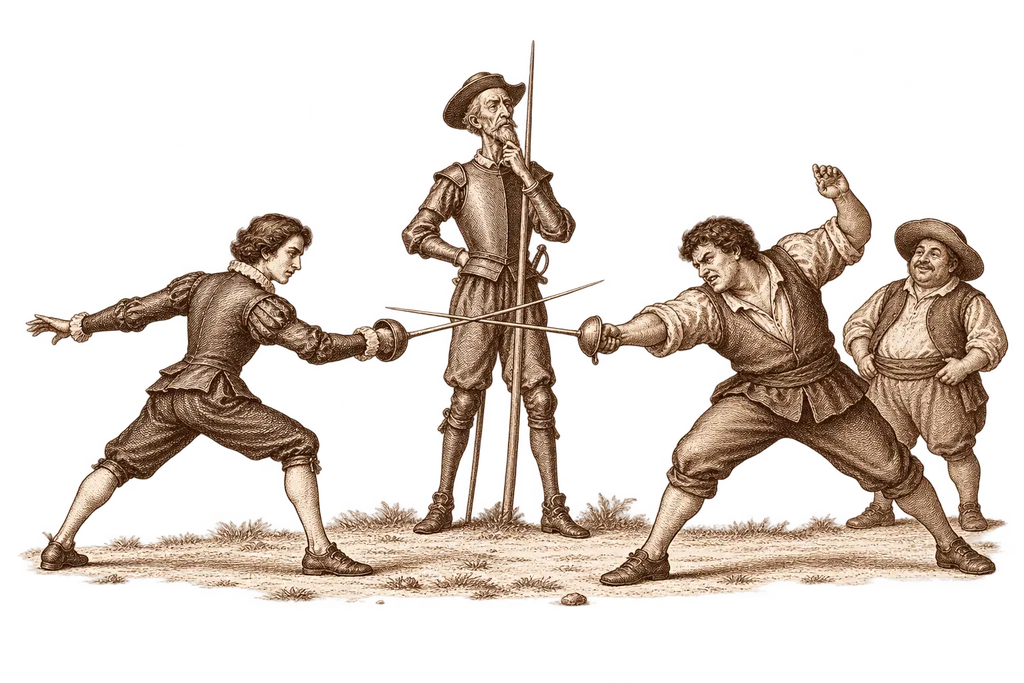
Don Quixote and Sancho join two students and two villagers traveling to the wedding of wealthy Camacho and beautiful Quiteria. A student explains that Quiteria and Basilio have loved each other since childhood, but her father chose the rich suitor. They discuss marriage and Basilio's abilities. Corchuelo then challenges the graduate, who defends fencing as an art. Don Quixote judges their contest. The graduate's technique defeats Corchuelo's strength, and Corchuelo acknowledges his mistake. Near the village they see lights and preparations, but Don Quixote chooses to sleep outdoors.
What to notice
A local informant tells the love story. The fencing dispute, by contrast, receives a visible test and ends with the loser accepting what he learned.
Analysis
The episode places wealth and ability alongside each other as ways of valuing a person. The fencing display also offers an unusual response within these adventures: Revising an opinion after defeat. It contrasts with explanations that always preserve an earlier conviction.
A reflection for today
In a practical disagreement, testing a claim may help more than repeating it forcefully. Corchuelo invites reflection on accepting an unfavourable result and learning from it without turning correction into hostility.
Sources and edition
This guide uses Cervantes’s text in Francisco Rodríguez Marín’s La Lectura edition (1911–1913), volume 6, II.19. Verifiable locator: Identifier donquijotedelama06cerv, scan images 10–29 (zero-based digital index). The heading and selected passages were visually checked; the complete notes were not collated. Analysis and present-day reflection are this guide’s commentary.

