A first attempt to correct an injustice leaves its victim worse off. A later defense of Dulcinea ends with Don Quixote beaten on the road.
On this page
Chapter summary
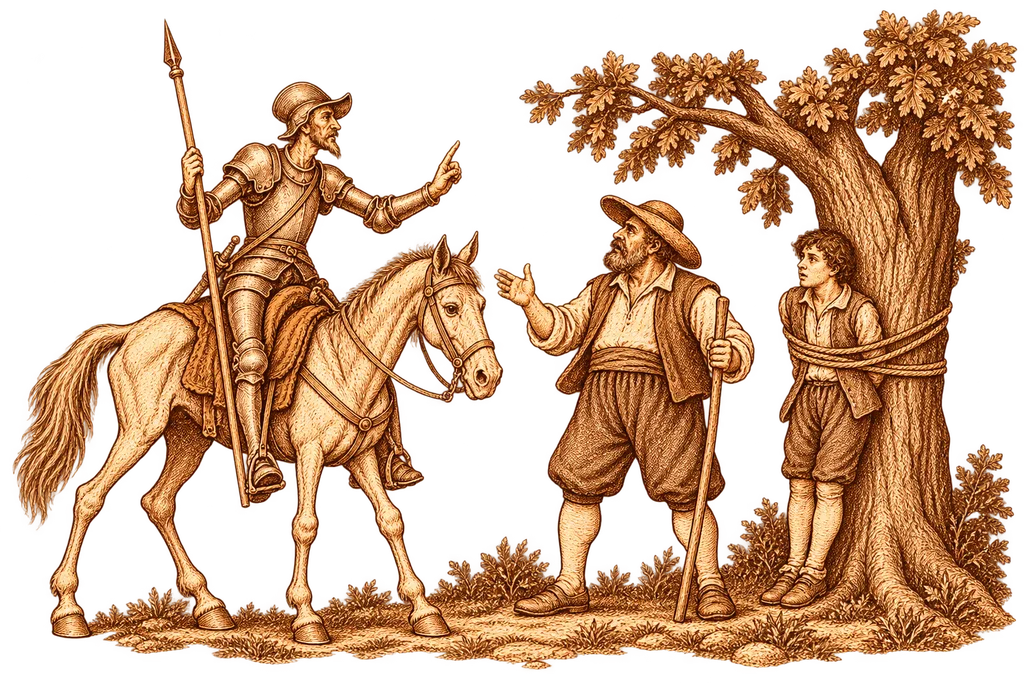
Don Quixote heads home to obtain supplies. Hearing cries, he finds Andrés being whipped by Juan Haldudo, who also owes the boy wages. He makes Haldudo promise to pay. Andrés warns that his master will punish him once the knight leaves, but Don Quixote trusts the promise and rides away pleased. Haldudo ties Andrés up again and beats him even more severely.
Don Quixote then encounters merchants from Toledo traveling to buy silk in Murcia. He demands that they declare Dulcinea incomparably beautiful without having seen her. Their mockery provokes a charge, but Rocinante trips before reaching the merchant. Don Quixote falls and cannot rise under the weight of his equipment. A mule servant breaks his lance and beats him with the pieces.
Characters and relationships
Andrés understands Haldudo’s behavior better than his would-be protector does. Haldudo says what the armed visitor wants to hear, then regains control after his departure. The merchants ask for evidence before praising an unknown woman; a servant turns the quarrel into a beating.
Analysis: Trust and proof
Both episodes test the basis of a claim. Don Quixote accepts Haldudo’s word without securing its fulfillment, then asks the merchants for belief without evidence. His certainty organizes his own world, but it cannot ensure obedience or shared values.
Readers learn the outcome that Don Quixote misses. His pleasure in the rescue becomes bitter irony because Andrés has suffered further harm. Rocinante’s stumble brings the next confrontation back to bodies, the ground, and the weight of armor.
Humor, language, and narrator
The language of honor creates a solemn-looking settlement that collapses when the force behind it disappears. The merchants’ scene sets a lofty challenge against a physical fall. Its comic structure does not erase the cruelty suffered by Andrés or by the knight.
A reflection on the chapter
Helping requires attention to what happens after an intervention. Andrés names a specific danger and is not heard. The episode encourages us to judge help by the recipient’s continuing safety and circumstances, rather than by the helper’s immediate sense of success.
Source and reading
Cervantes’s text in Rodríguez Marín’s La Lectura edition (1911–1913), volume 1. Checked passages: P. 118, p. 123, p. 125, p. 129, p. 130. Original summary, analysis, and reflection by QuixoteGuide.


