Don Quixote sets out alone, then realizes that he has never been knighted. At nightfall, a roadside inn becomes, in his interpretation, the castle where that problem can be solved.
On this page
Chapter summary
One July morning, Don Quixote leaves home secretly. Remembering that he lacks formal knighthood, he decides to have the first suitable person confer it. As he rides, he imagines a future historian describing his achievements and speaks in the language of chivalric romances.
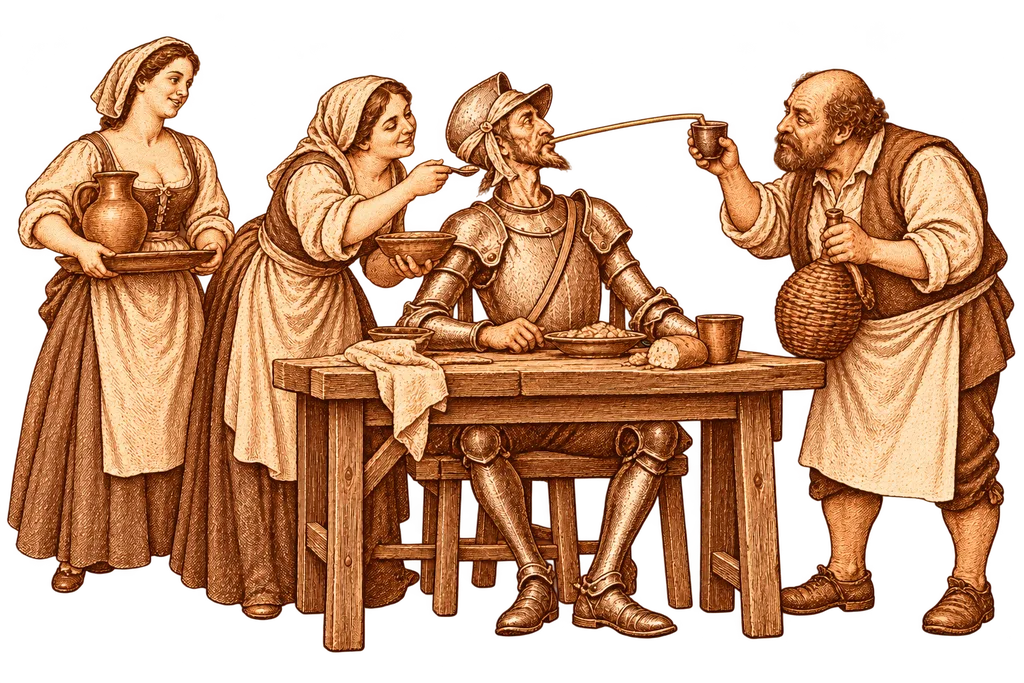
After a day without adventures, he reaches an inn hungry and tired. He sees a castle and treats two women there as noble maidens. The innkeeper receives him cautiously and tends to Rocinante. The women remove part of his armor, but his helmet stays on because he will not let them cut its ribbons. They help him eat, and the innkeeper pours wine through a hollow reed. Don Quixote reads this awkward meal as a knightly welcome, yet remains troubled by his lack of knighthood.
Characters and relationships
Don Quixote travels without a squire. The innkeeper and two women meet his practical needs without sharing his interpretation. Sounds made by men working with pigs become part of his imagined castle reception. Rocinante needs rest rather than a heroic encounter.
How the chapter works
Readers receive both the event and Don Quixote’s version of it. The inn never physically becomes a castle; his expectations reshape its meaning. Hunger and the helmet make the would-be hero dependent on people he assigns elevated roles.
Narrator, humor, and language
The hero rehearses his future fame before achieving anything. That imagined account contrasts with an uncomfortable arrival and a difficult meal. His archaic speech creates confusion and laughter: Adopting a style does not make others recognize the identity he wants to perform.
A present-day reflection
Our reading: Expectations can absorb so much evidence that correction becomes difficult. Don Quixote turns farm sounds and poor food into signs of noble hospitality. The episode suggests checking what could disprove an explanation before treating every detail as another reason to believe it.
Source and reading
Miguel de Cervantes, edited and annotated by Francisco Rodríguez Marín, La Lectura, 1911–1913, volume 1. Checked passages, pages 69, 76, 83, 87. View the opening facsimile page. Original summary, explanations, and reflection by QuixoteGuide.
