A rest in the countryside ends in a beating. Rocinante starts an adventure his owner did not choose.
On this page
Summary
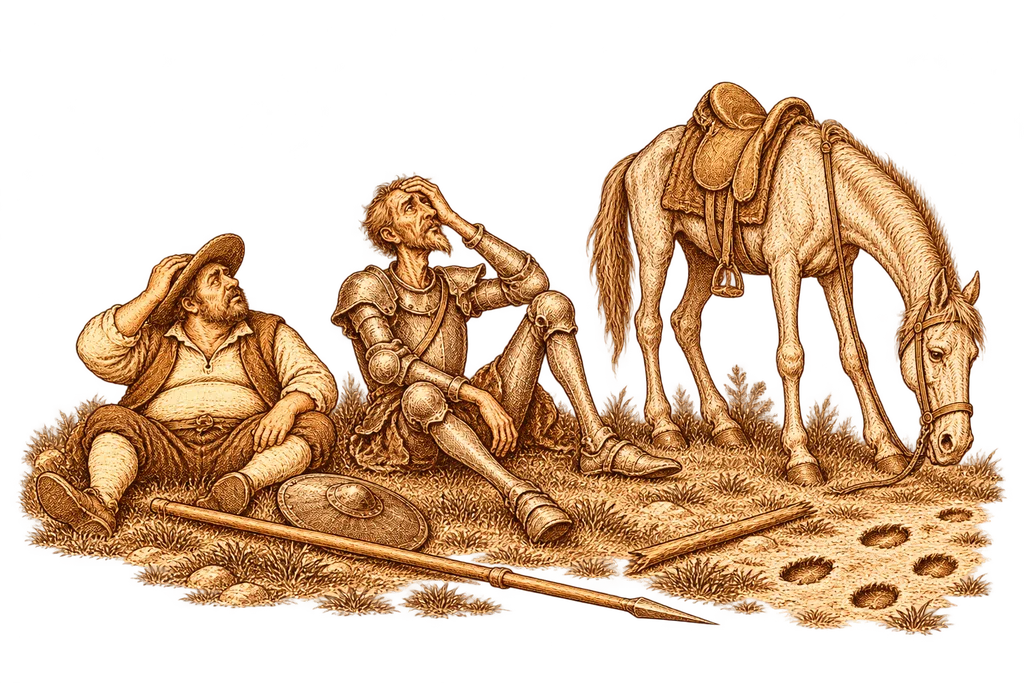
After Grisóstomo’s burial, Don Quixote and Sancho look unsuccessfully for Marcela. They stop in a meadow, where the unrestrained Rocinante approaches some mares. The animals reject him and their carriers beat him.
Master and squire attack the carriers despite being badly outnumbered. Both are beaten. Don Quixote explains the defeat as a breach of chivalric rules: The opponents were not knights. He tries to assign such fights to Sancho, who objects by recalling his peaceful nature and his family. They carry the injured knight across the donkey and reach an inn that he treats as a castle.
Characters and relationships
Rocinante starts the trouble without sharing his owner’s ideals. Sancho joins the attack but subsequently questions his assigned duties. The carriers defeat heroic calculation with physical strength.
Narrative techniques
A horse’s approach to some mares replaces the anticipated grand adventure. After the beating, conversation turns defeat into a lesson in literary rules. Sancho answers those rules with bodily pain.
Humor, language and narrator
The gap between confident arithmetic and the outcome creates comedy. The knight’s distinctions between honorable and dishonorable blows seem fragile beside the need for rest.
Reflection
Don Quixote distributes responsibility according to a hierarchy only he has accepted. Sancho draws a boundary by invoking his family and his reluctance to fight. The scene asks whether a leader may impose on a companion the dangers created by his own confidence.
Source and reading
Cervantes’s text in Rodríguez Marín’s La Lectura edition (1911–1913), volume 2. Checked passages: P. 10, p. 12, p. 15, p. 26. Original summary, analysis, and reflection by QuixoteGuide.


