After the duel, master and squire negotiate the rules and consequences of their journey.
On this page
Summary
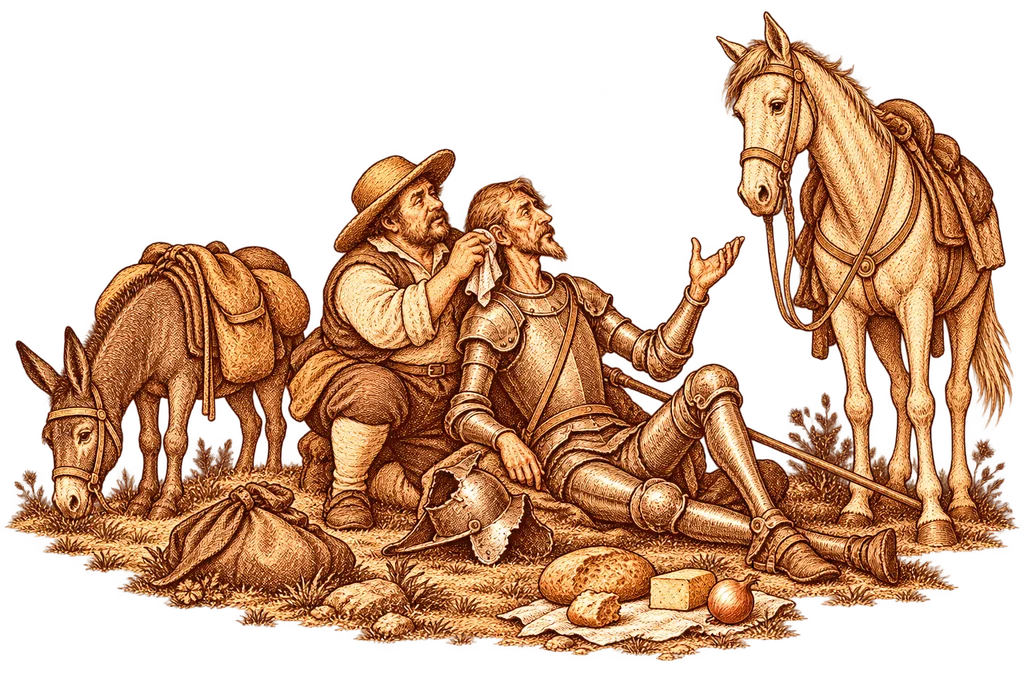
Sancho asks for the island he thinks the battle has won. Don Quixote explains that this kind of encounter yields no territory. Sancho fears the Holy Brotherhood and offers to dress his master’s injured ear. Don Quixote describes the supposedly extraordinary balm of Fierabrás; Sancho imagines earning money from its recipe.
The broken helmet prompts a vow of revenge. Sancho points out that the defeated man already owes a visit to Dulcinea, and Don Quixote withdraws that part of the oath. They eat modest provisions and reach some goatherds’ huts.
Characters
Sancho combines hope of reward, concern about justice, and care for his master. Don Quixote holds to his ideal but can accept an objection expressed within the rules he recognizes.
Analysis
Sancho measures the victory against the agreement that persuaded him to leave home. He wants to know which island his master has won and when he will receive its government. Don Quixote distinguishes adventures that produce territories from encounters that produce injuries. This classification preserves the promise while postponing delivery. Their conversation shows an expectation surviving the first outcome that fails to match it.
The balm of Fierabrás offers another bridge between heroic narrative and an injured body. Don Quixote imagines a remedy that can reunite a severed body; Sancho considers the value of knowing its recipe. While discussing an extraordinary cure, they still require the lint and ointment actually available in the saddlebags. The marvelous explanation does not remove the need for practical care.
Sancho also limits an oath of vengeance by invoking his master’s own conditions. If the Basque attendant obeys the order to appear before Dulcinea, he should not receive a second punishment. Don Quixote accepts the objection and changes his vow. This qualifies the picture of an entirely closed certainty: He can hear an argument framed within the chivalric terms he recognizes. Their relationship begins to develop through negotiation as well as obedience.
Humor and language
The marvelous cure inspires calculations about production and sales. Territorial ambition meets onion, cheese, and bread. A painful body keeps the conversation connected to immediate needs.
Reflection
An objection can work by exposing a conflict between a new decision and an existing commitment. Sancho checks revenge by recalling the earlier settlement. Shared consistency opens a door that ridicule would probably close.
Source and reading
Cervantes’s text in Rodríguez Marín’s La Lectura edition (1911–1913), volume 1. Checked passages: P. 228, p. 236, p. 238. Original summary, analysis, and reflection by QuixoteGuide.
Read the chapter in English. Read Part 1, Chapter 10 in English in John Ormsby’s translation, via Project Gutenberg. Compare it with the Spanish source cited above; our summary and commentary are separate from the translation.