The new journey opens with conversation rather than combat. Traveling toward Dulcinea allows heroic fame to be compared with a religious form of recognition that Sancho considers more effective.
On this page
Characters and setting
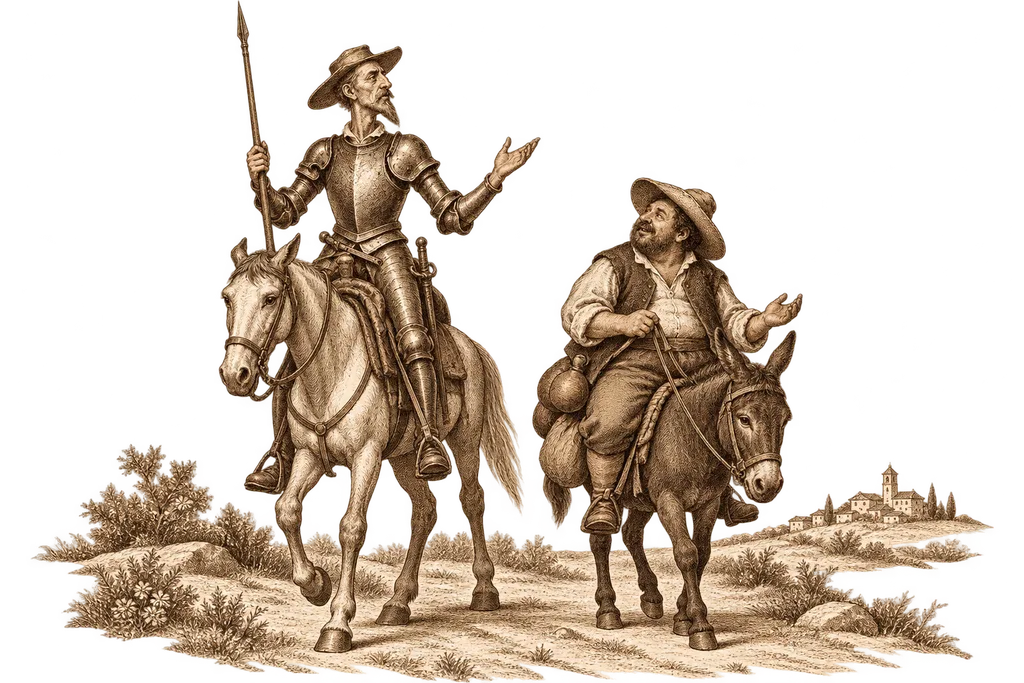
Characters: Don Quixote and Sancho. Dulcinea is the lady they discuss and the reason for their journey. Setting: The road to El Toboso.
Summary
Don Quixote wants to visit Dulcinea before undertaking adventures. Sancho maintains his earlier story of seeing her at work; his master explains this through enchantment. They discuss reputation, the desire to preserve a name and examples of people pursuing fame at any cost. Sancho asks about heroes' tombs and compares their fame with the veneration of saints. He proposes pursuing sainthood. Don Quixote insists that knighthood can lead to heaven. Near El Toboso, Sancho fears having to find a house he does not know.
What to notice
Sancho redirects his master's reasoning through their shared objective: If good fame is the aim, he proposes another route. The ending exposes the gap between his previous account of Dulcinea and his actual knowledge.
Analysis
The road toward Dulcinea connects reaching a person with preserving a name. Don Quixote wants to visit his lady before beginning further adventures, while Sancho must sustain an earlier embassy he did not perform as he reported. Nearness to El Toboso turns that account into a practical problem. An explanation adequate while the house was far away must now face the possibility of actually looking for it. Conversation prolongs their journey without removing the unresolved difficulty.
Examples of fame distinguish being remembered from deserving honorable remembrance. Herostratus shows that a name can survive precisely because of a destructive deed. Sancho introduces another measure through the veneration of saints and his suggestion that they pursue that path. His comparison gives honor, usefulness and recognition a logic different from knightly exploits. Don Quixote replies that the profession of arms can also lead to heaven, so the disagreement does not end in a simple rejection of religion or chivalry. Identify the reward each speaker seeks through fame. The chapter prepares their visit while examining the reasons these travelers want their lives to become stories others will remember.
A reflection for today
Before pursuing recognition, we can ask what kind we want and what we are willing to do for it. The chapter distinguishes a lasting name from the worth of actions. This current interpretation examines a goal without attributing our categories of professional or digital reputation to Cervantes.
Sources and edition
This guide uses Cervantes’s text in Francisco Rodríguez Marín’s La Lectura edition (1911–1913), volume 5, II.8. Verifiable locator: Identifier donquijotedelama05cerv, scan images 147–163 (zero-based digital index). The heading and selected passages were visually checked; the complete notes were not collated. Analysis and present-day reflection are this guide’s commentary.
Read the chapter in English. Read Part 2, Chapter 8 in English in John Ormsby’s translation, via Project Gutenberg. Compare it with the Spanish source cited above; our summary and commentary are separate from the translation.